

My name is Jaap, and I am a biomedical scientist that also used to live with severe Hidradenitis Suppurativa, the kind that takes over your life. Today, I am completely asymptomatic because I learned how to heal Hidradenitis Suppurativa from within. More importantly, I’ve had the privilege of helping many other individuals with HS get their lives back too.
A Proven natural Roadmap to Manage HS
Get the support and natural strategies you need for lasting relief and join a community that understands.

Introduction: When HS Dictates Your Life
Have you ever felt like Hidradenitis Suppurativa isn’t just affecting your skin, but dictating the very course of your life? Maybe you hesitated to pursue a certain career because of potential flares, avoided relationships out of fear or shame, or changed your lifestyle in ways you never wanted to. It’s that heavy feeling that this disease casts a long shadow over your most important decisions, the impact of hidradenitis suppurativa reaching far beyond the physical pain. You’re not imagining it.
For years, the medical community has acknowledged the significant burden HS places on hidradenitis suppurativa quality of life. We know about the pain, the psychological distress, and the social isolation. But a crucial aspect often remained unspoken: how HS actively interferes with Major Life-Changing Decisions (MLCDs), those pivotal choices about our careers, education, relationships, and fundamental lifestyle.
Now, a new study is bringing this hidden toll into the light. Research conducted by Dr. Clara Ureña-Paniego and colleagues in Spain meticulously quantified just how profoundly HS influences these critical life choices [1]. Their findings validate the experiences many of us have lived through and underscore why a superficial approach to treating HS is simply not enough. Understanding this deep impact reinforces the absolute necessity of addressing the root cause, the systemic inflammation driving the disease, which is the core philosophy we live by at HS Arma. Let’s explore what they found and what it means for reclaiming your future.
More Than Skin Deep: The Heavy Weight of HS on Life’s Biggest Choices
Before diving into the specifics, I want to extend a sincere thank you to Dr. Ureña-Paniego and her team at the Hospital Universitario Virgen de las Nieves in Granada. Their work, a cross-sectional study involving 50 HS patients, gives us invaluable data to understand and articulate the far-reaching consequences of this disease.
The concept of Major Life-Changing Decisions (MLCDs) acknowledges that chronic illness doesn’t just cause daily symptoms; it can fundamentally alter the trajectory of a person’s life. While studied in other conditions, its relevance to HS has been largely unexplored until now. This study aimed to bridge that gap, asking patients directly how HS influenced decisions across various domains: work, education, relationships, lifestyle, and even choices about things like holidays or housing. Participants rated the impact on a 4-point scale, giving us a clear picture of where HS hits hardest.
A Proven natural Roadmap to Manage HS
Get the support and natural strategies you need for lasting relief and join a community that understands.

The Unseen Toll: Which Decisions Does HS Impact Most?
The study’s results paint a stark picture. HS doesn’t just inconvenience; it actively interferes. The domains most significantly impacted were:
- Job Performance: This topped the list, with over 61% of patients reporting a moderate to high impact. This includes difficulties in choosing a job, performing daily tasks, missing out on promotions, and increased absenteeism.
- Clothing Choices: Affecting over 57% of patients. This reflects the daily struggle of managing pain, drainage, and discomfort, forcing choices based on practicality rather than personal preference.
- Sports Practice: Also impacting over 57%. Pain, friction, and sweat can make physical activity incredibly challenging, limiting participation in activities crucial for physical and mental well-being.
- Lifestyle Changes: Over 55% reported significant impacts here, encompassing broader adjustments forced by the disease.
Other significantly affected areas included sexual impairment, choice of partner, travel, socialization, and family relationships. Education also suffered, impacting performance and the ability to achieve desired educational levels, especially, as we’ll see, when the disease starts early.
It’s worth noting that some areas, like decisions about job promotion, early retirement, parenthood, and housing, were less affected on average. However, the profound impact on core areas like work, daily choices, and physical activity highlights how HS can erode the foundations of a fulfilling life.
A Proven natural Roadmap to Manage HS
Get the support and natural strategies you need for lasting relief and join a community that understands.
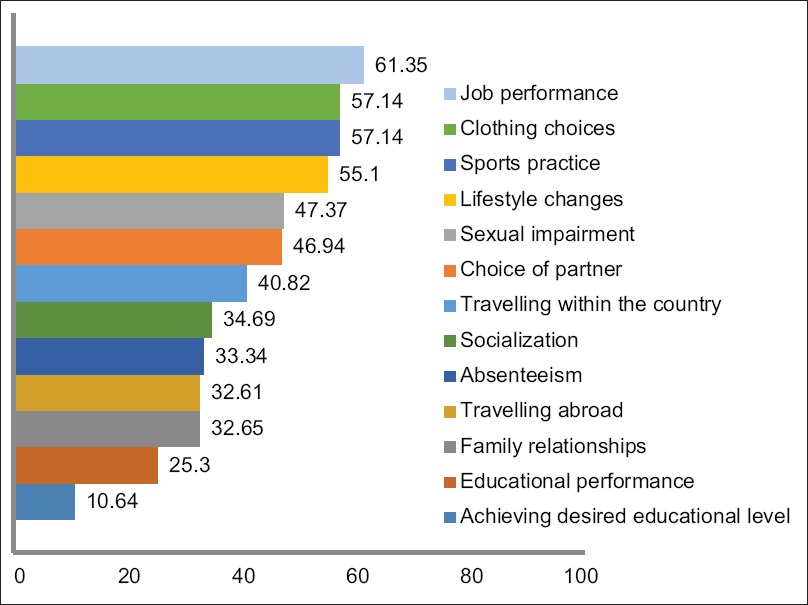
Figure 1 Legend: Percentage of patients showing a moderate or high impact of HS on different MLCD. Figure by Dr. Ureña-Paniego and colleagues. The bar chart displays the percentage of 50 HS patients who reported that the disease had a moderate or high impact on various Major Life-Changing Decisions (MLCDs). Job performance was the most affected domain (61.35%), followed closely by clothing choices (57.14%), sports practice (57.14%), and general lifestyle changes (55.1%). Other significantly impacted areas include sexual impairment, choice of partner, travel, socialization, and absenteeism. Educational performance and attainment were less frequently cited but still affected. This visualization starkly illustrates the wide-ranging influence of HS beyond just physical symptoms.
Who Carries the Heaviest Burden? Factors That Amplify the Impact
The study didn’t just quantify the what; it explored the who. Several factors were linked to a greater negative impact of HS on life decisions:
- Female Sex: Women reported a significantly higher impact on job performance, lifestyle habits, and clothing choices compared to men. The researchers suggest this could be due to societal pressures, the psychological burden, and potentially the greater impact HS has on female sexual function and distress documented in other studies.
- Higher Education: Interestingly, patients with higher education levels felt HS impacted their job performance and lifestyle habits more acutely. This might reflect higher career aspirations or lifestyle expectations, making the limitations imposed by HS feel more restrictive.
- Disease Severity (Hurley Stage): As expected, higher Hurley stages were linked to greater impacts, particularly on job performance, sexual health, and even domestic travel. This underscores how disease progression deepens its interference in life.
- Early Disease Onset: Starting HS symptoms at a younger age had a significantly negative impact on the education domain. Battling a chronic, painful condition during formative school years can understandably hinder academic achievement.
- Missing the “Window of Opportunity”: This concept refers to the critical early period where timely and effective treatment (often involving biologics) might alter the long-term course of the disease. The study found that patients who missed this window experienced greater negative impacts later on, particularly in job/career domains and even in relation to toxic habits (like smoking or drug use). This tragically highlights the long-term cost of diagnostic delays and ineffective early management.
A Proven natural Roadmap to Manage HS
Get the support and natural strategies you need for lasting relief and join a community that understands.

The Doctor vs. Patient Divide: Why Your Experience Might Feel Underestimated
One of the most validating, yet concerning, findings was the significant disconnect between how patients and dermatologists perceived the impact of HS. Even when they roughly agreed on the clinical severity (like Hurley stage), dermatologists consistently underestimated how much HS hindered patients’ life choices. The kappa coefficient, a measure of agreement, was incredibly low (0.02), indicating almost no agreement on the hindering effect.
Why does this happen? The researchers suggest it’s tied to the subjective experience of pain and psychological distress, which isn’t easily captured by clinical scores but profoundly shapes a patient’s reality. Other studies have also noted this poor concordance. This finding is crucial. It validates that feeling you might have had in the doctor’s office – that your description of the disease’s impact isn’t fully landing. It underscores the vital need for healthcare providers to listen deeply and trust the patient’s reported experience, recognizing that the true burden of HS often lies beneath the visible surface.
Beyond Managing Symptoms: The Real Cost of Delay and Superficial Treatment (The Knowledge Gap)
This study, while focused on MLCDs, perfectly illuminates the knowledge gap inherent in the conventional approach to treating HS. The finding that missing the window of opportunity leads to greater long-term negative impacts on careers and fosters detrimental habits is a direct indictment of a system often focused on downstream symptom management rather than upstream, root-cause resolution.
Think about it: the average 10-year diagnostic delay means a decade where the systemic inflammatory fire is allowed to burn. During this time, patients are often given treatments for isolated abscesses or infections, never addressing the underlying immune dysregulation. This study shows the tangible, life-altering consequences of that delay: worsened disease severity, more surgeries, and a greater accumulation of comorbidities like arthritis and depression.
The conventional model often introduces powerful drugs like biologics later in the disease course, acting as a shield against severe inflammation. While sometimes necessary, this approach doesn’t fundamentally fix the problem. The system’s failure lies in not prioritizing strategies early on that address the reasons for the inflammation, the dietary triggers, the lifestyle factors, the metabolic dysfunction. This study demonstrates the devastating cost of that failure, measured not just in skin lesions, but in altered life paths and diminished potential.
A Proven natural Roadmap to Manage HS
Get the support and natural strategies you need for lasting relief and join a community that understands.

Reclaiming Your Future: How a Root-Cause Approach Changes the Equation (The HS Arma Philosophy)
So, how do we escape this cycle? How do we prevent HS from dictating our major life decisions? The answer lies in shifting our focus from merely managing the disease to actively building a foundation of health. This is the heart of the HS Arma philosophy. We believe the natural treatment of HS, focused on root causes, is the primary treatment, not an optional add-on.
This study validates our approach by showing the devastating consequences of unchecked, systemic inflammation. By focusing on extinguishing that fire from within, we aim to lessen the burden that leads to these negative impacts on MLCDs:
- Foundational Nutrition: We help you identify personal food triggers that fuel inflammation, thereby reducing disease severity (a key factor impacting MLCDs). Nourishing your body correctly provides the energy needed to engage fully in work and life.
- Strategic Lifestyle Changes: Managing stress and optimizing sleep directly impacts the immune system and reduces the psychological burden. This can lessen the impact on mental health and improve overall resilience, supporting better job performance and social engagement.
- Natural Therapies & Skincare: Targeted, science-backed natural compounds help balance the immune system and reduce inflammation systemically. Effective skincare helps manage symptoms externally, reducing the daily discomfort that impacts clothing choices and physical activity.
- Accountability & Support: Addressing the social isolation highlighted implicitly by the study, our community provides understanding and shared experience, reducing the psychological toll. Guidance helps maintain the commitment needed for lasting change.
- Targeted Medical Testing: Empowering you with information helps bridge the patient-doctor communication gap identified in the study, leading to more effective, personalized care plans.
Our goal is to build such a strong foundation of health that the physical and psychological burden of HS diminishes, freeing you to make life choices based on your aspirations, not your limitations. We aim to make powerful drugs and surgeries less necessary, or ideally, completely unnecessary, by addressing the problem at its source.
A Proven natural Roadmap to Manage HS
Get the support and natural strategies you need for lasting relief and join a community that understands.

Key Takeaways
- HS Profoundly Impacts Life Choices: Hidradenitis Suppurativa significantly affects major decisions about jobs, lifestyle, clothing, and sports, extending far beyond daily symptoms.
- Key Factors Amplify Impact: Being female, having higher education, greater disease severity (Hurley stage), early symptom onset, and missing early treatment opportunities are linked to a greater negative influence on life choices.
- Patient Experience is Often Underestimated: Dermatologists tend to underestimate the degree to which HS hinders patients’ lives compared to patients’ own reports.
- Delay Has Long-Term Costs: Failing to address the root cause of HS early on (often due to diagnostic delay) leads to more severe disease, more surgeries, and more related health problems down the line.
- Root-Cause Healing Offers Hope: A foundational, natural approach focused on reducing systemic inflammation through diet, lifestyle, and natural therapies aims to lessen the disease burden, empowering individuals to reclaim control over their major life decisions.
Conclusion: You Are More Than Your Diagnosis
This study provides crucial, validating data about the true impact of hidradenitis suppurativa. It confirms that the weight of this disease extends into the very fabric of our lives, shaping our careers, relationships, and daily choices in profound ways. The disconnect between patient experience and clinical perception, coupled with the high cost of delayed or superficial treatment, highlights the urgent need for a more holistic, patient-centered approach.
But let this knowledge be a source of empowerment, not despair. Understanding the depth of the impact reinforces why settling for mere symptom management is not enough. You deserve a life where your choices are driven by your dreams, not by your disease. By embracing a foundational, root-cause approach (by committing to treat hidradenitis suppurativa from the inside out) you can begin to extinguish the inflammatory fire. This is the path to reducing the burden, reclaiming your agency, and achieving the lasting remission that allows you to write your own future. Healing is possible.
A Proven natural Roadmap to Manage HS
Get the support and natural strategies you need for lasting relief and join a community that understands.

References
- Ureña-Paniego C, Soto-Moreno A, Díaz-Calvillo P, Cuenca-Barrales C, Molina-Leyva A, Arias-Santiago S. Impact of hidradenitis suppurativa on major life-changing decisions: A cross-sectional study. Indian J Dermatol 2025;70:283-6. https://doi.org/10.4103/ijd.ijd_926_23
- Cuenca-Barrales C, Montero-Vilchez T, Krajewski PK, Szepietowski JC, Matusiak L, Arias-Santiago S, et al. Sexual dysfunction and quality of life in patients with hidradenitis suppurativa and their partners. Int J Environ Res Public Health 2023;20(1):389. https://doi.org/10.3390/ijerph20010389
- Samela T, Dattolo A, Cordella G, Antinone V, Mastroeni S, Fusari R, et al. Similar levels of disease severity correspond to a greater burden of illness in women compared with men with hidradenitis suppurativa. Acta Derm Venereol 2023;103:adv00877.https://doi.org/10.2340/actadv.v103.2558
- Singh R, Mohney L, Senthilnathan A, Feldman SR, Pichardo RO. Educational attainment is inversely correlated with hidradenitis suppurativa severity. Dermatol Online J 2022;28(3).https://doi.org/10.5070/D328357842
- Marzano AV, Genovese G, Casazza G, Moltrasio C, Dapavo P, Micali G, et al. Evidence for a “window of opportunity” in hidradenitis suppurativa treated with adalimumab: A retrospective, real-life multicentre cohort study. Br J Dermatol 2021;184(1):133-140.https://doi.org/10.1111/bjd.19066
- Schneider-Burrus S, Kalus S, Fritz B, Wolk K, Gomis-Kleindienst S, Sabat R. The impact of hidradenitis suppurativa on professional life. Br J Dermatol 2023;188(1):122-130.https://doi.org/10.1093/bjd/ljac031
Important Medical Disclaimer
1. Not Medical Advice: All content and information on this website is for informational and educational purposes only. It does not constitute medical advice and is not a substitute for professional diagnosis, treatment, or consultation with a qualified healthcare provider.
2. My Role and Qualifications: I am a biomedical scientist and PhD candidate and share information from that perspective, combined with my personal experience as a patient with Hidradenitis Suppurativa. However, I am not a medical doctor, physician, or registered healthcare professional. Do not consider our relationship a doctor-patient relationship.
3. Consult Your Doctor: Always seek the advice of your medical doctor or another qualified health professional with any questions you may have regarding a medical condition. Never disregard professional medical advice or delay seeking it because of something you have read on this website. If you suspect you are experiencing a medical emergency, or a severe infection, do not rely on this website or the HS Arma community, please call your local emergency services or go to the nearest emergency room immediately.
4. A Critical Warning on Medication: Pharmaceutical drugs are a crucial tool in managing Hidradenitis Suppurativa for many people. Under absolutely no circumstances should you ever alter, reduce, or stop taking your prescribed medication without the explicit direction of the doctor who prescribed it. Doing so can be dangerous. Always consult with your doctor before doing anything related to your treatment plan.
5. No Liability: Your use of this website and reliance on any information provided is solely at your own risk.
6. Individual Results May Vary: Every patient’s biological baseline, genetics, and adherence to the protocol is different. Therefore, I cannot guarantee specific results, cures, or timelines for your Hidradenitis Suppurativa.
7. Scientific and Expressive Freedom: The articles published on this blog are distinct from formal peer-reviewed academic literature. They serve as an independent platform for my personal viewpoints, scientific hypotheses, and philosophical reflections as an independent scientist and HS patient. While grounded in biomedical research, I exercise a degree of expressive freedom to translate rigid academic data into insights from a patient perspective. These writings are my personal meditations on the science of HS and should be read as my individual perspective, not as universally accepted clinical consensus or formal peer-reviewed literature.