
Inflammatory Flux and Disease Progression in Hidradenitis Suppurativa: A Multi-Compartment Deterministic Model Simulating Lifestyle and Pharmaceutical Interventions in In Silico Cohorts
Jaap-Jan Roukens
Keywords: Hidradenitis suppurativa, Mathematical modeling, In silico clinical trials, Systems biology, Pharmacokinetics, Biologics, Antibiotics, Corticosteroids, Inflammatory flux, lesion hysteresis, lifestyle.
https://www.preprints.org/manuscript/202603.0022
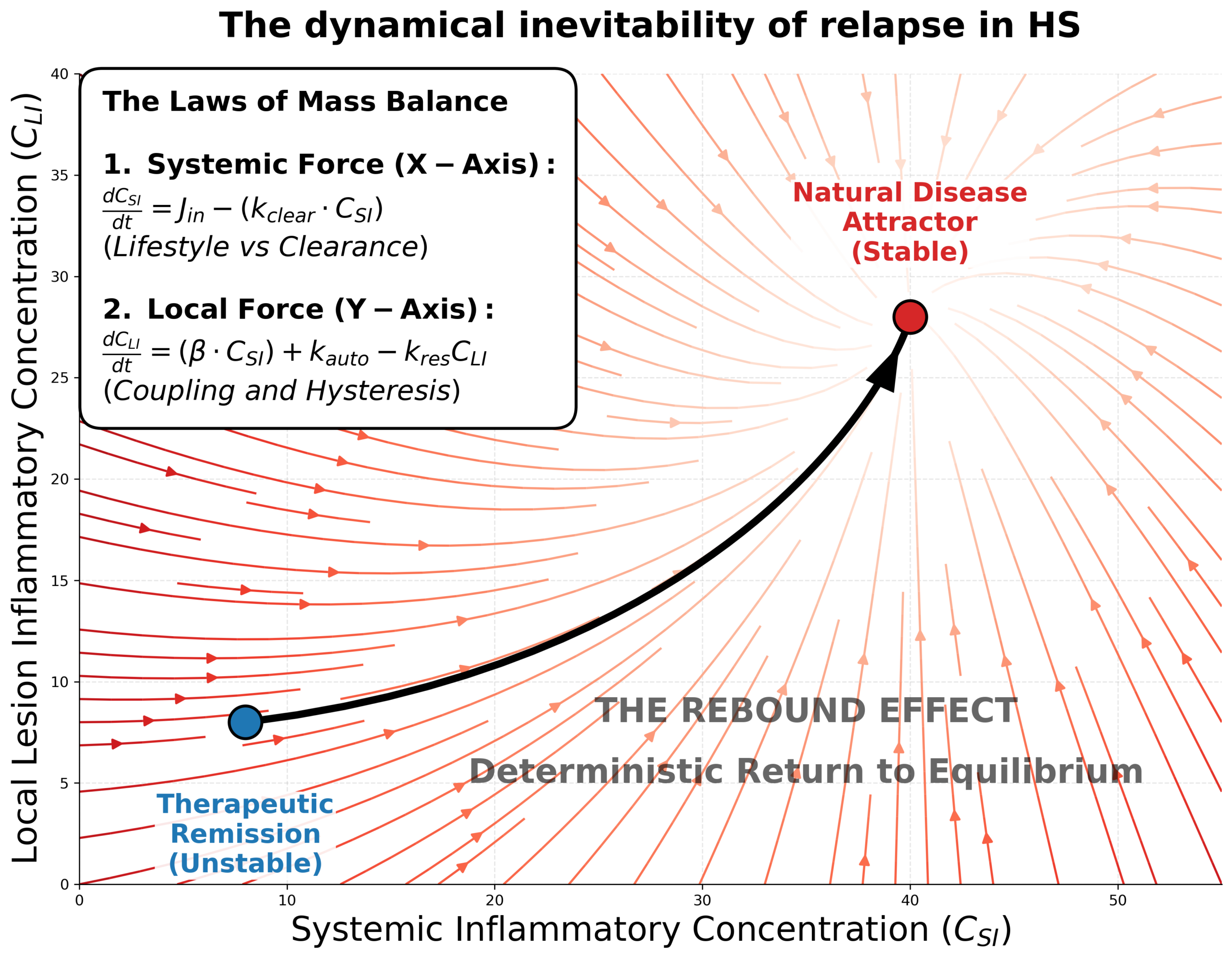
The relapse trajectory (phase plane). Two-dimensional vector field analysis of the coupled systemic (𝐶 ) and local (𝐶 ) differential equations. The arrows represent the gradient vector field 𝑉 = 𝑑𝐶𝑆𝐼 /𝑑𝑡 , 𝑑𝐶𝑆𝐼 /𝑑𝑡 . The black line traces the deterministic path of a patient post-drug failure; starting from remission (blue dot), the system is captured by the vector field and pulled inevitably back to the Disease Equilibrium (red dot), confirming that without altering the input flux (J_in), the system retains a permanent memory of the disease state.
Abstract
While recent reviews have firmly established hidradenitis suppurativa (HS) as a systemic inflammatory disorder inextricably linked to metabolic comorbidities, the investigation of lifestyle determinants remains a fraction of the research effort compared to the pursuit of pharmaceuticals. Consequently, current clinical approaches may not fully leverage natural modulators of systemic environmental inflammatory influx, a potential driver of the disease. The central premise of this study posits that the compromise of follicular integrity is directly coupled to lifestyle-driven systemic inflammation exceeding a critical threshold. While previous studies have relied on statistical regression and probabilistic frameworks for HS, this study establishes a deterministic multi-compartment ordinary differential equation framework to simulate the longitudinal kinetics of systemic and local lesion inflammation. Represented in this framework is the first mathematical formalization of the 2025 European S2k guideline interventions, explicitly modeling the resistance kinetics of antibiotics, the immunogenic decay of biologics, and the tapering dynamics of corticosteroids to simulate their longitudinal efficacy in HS. Furthermore, we introduce an abstractified framework that applies the laws of mass balance and pharmacokinetics directly to the disease state and key biologically relevant parameters, rather than focusing on cell types, targets, and individual cytokines. In this HS PK model, the lesion is connected to the systemic inflammation and acts as an integrator and amplifier, recording transient systemic spikes as permanent structural debt through an effect of hysteresis that progressively decouples the lesion from the systemic driver. Simulation studies suggest biologic agents provide a buffering capacity that creates a therapeutic equilibrium, which differs from resolving the underlying inflammatory mass balance. When evaluated across a virtual cohort, this reveals distinct kinetic populations. We demonstrate that clinical rebound is mathematically governed by phase space topology, where the disease state acts as a stable natural equilibrium. Upon pharmaceutical cessation, the therapeutic equilibrium collapses, causing the system to shift rapidly back to the disease state, driven by the underlying inflammatory load. Consequently, a comparative rescue trial demonstrated that pharmacological escalation encounters a saturation ceiling. This suggests that sustainable remission in HS may require a transformation that shifts the equilibrium itself, redefining lifestyle modification from an adjuvant option to the fundamental variable required to treat HS effectively.
Behavioral Feedback Loops and Kinesiophobia in Hidradenitis Suppurativa: A Conceptual Framework.
Jaap-Jan Roukens
Keywords: Hidradenitis suppurativa, Psychiatric comorbidities, Lifestyle modifications, Systemic inflammation, Fear-avoidance model.
https://www.preprints.org/manuscript/202603.0674
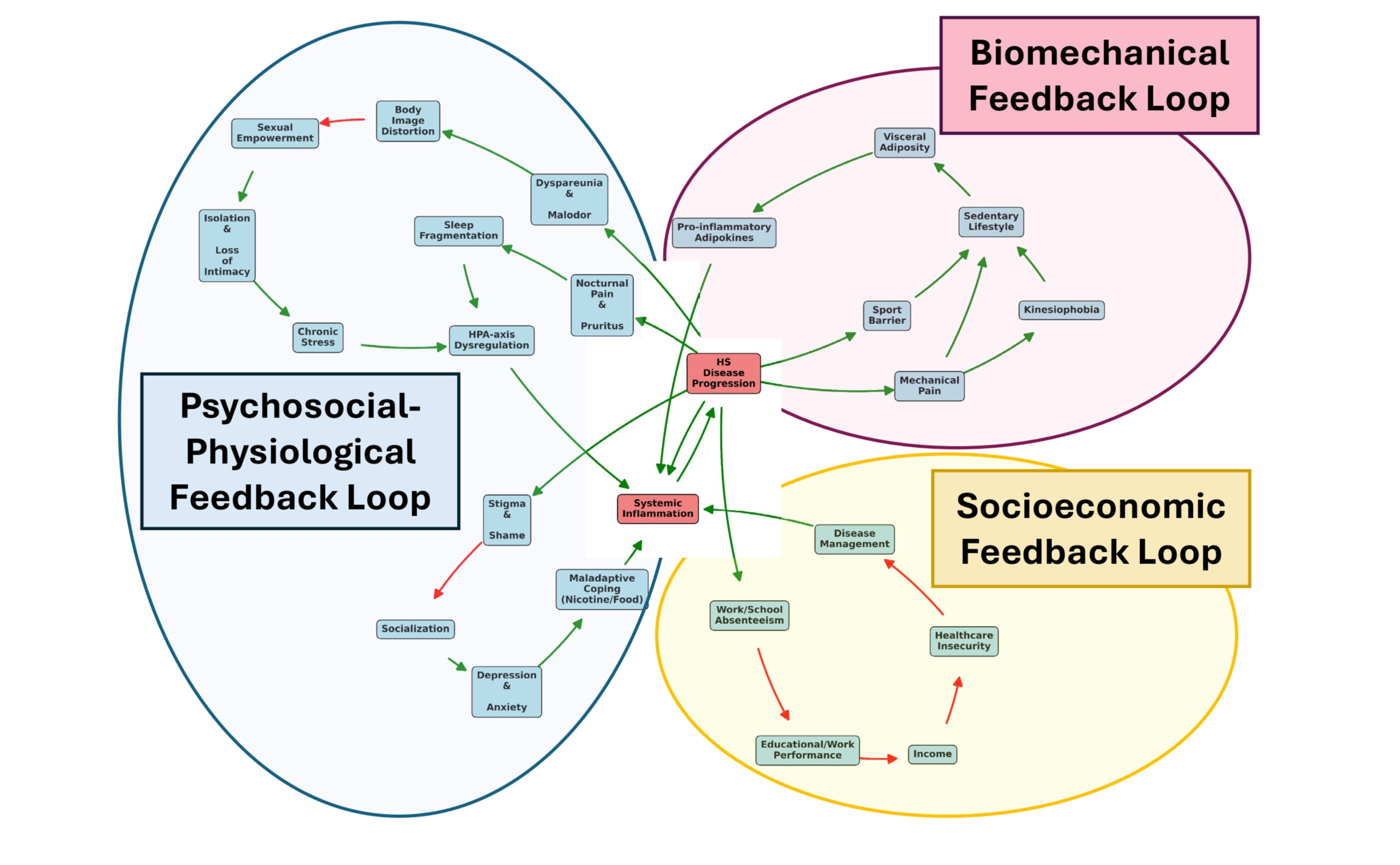
Conceptual framework of behavioral feedback loops in hidradenitis suppurativa. This directed pathological cascade diagram illustrates the biomechanical, psychosocial, and socioeconomic behaviors that contribute to disease chronicity. The central red nodes represent the core pathophysiological mechanism of bidirectional amplification between systemic inflammation and disease progression. Blue intermediate nodes demonstrate how downstream disease progression influences systemic inflammation. Black bidirectional arrows represent the crosstalk between these three domains.
Abstract
Hidradenitis suppurativa (HS) is a severe inflammatory dermatosis characterized by debilitating localized pain. Current feedback models of HS focus on microscopic molecular networks and bacterial dysbiosis. To address this gap, this narrative review integrates the individually well-documented psychosocial and behavioral burdens of the disease into a single positive feedback model. This conceptual framework operates across three domains: (1) a biomechanical-metabolic loop, where sustained immobility may accelerate the accumulation of visceral adiposity and insulin resistance; (2) a psychosocial loop, where symptom-induced psychiatric comorbidities may contribute to neuroendocrine dysregulation and compensatory coping behaviors; and (3) a socioeconomic loop, where economic instability can decrease healthcare security and hinder effective disease management. Consequently, these interconnected burdens may result in increased systemic inflammation, which in turn exacerbates the pathophysiology of HS. Moreover, this review proposes kinesiophobia (the anticipatory fear of movement) as a hypothesized component of the biomechanical-metabolic feedback loop. Currently, there is a notable absence of primary psychometric data quantifying kinesiophobia in the HS population. Future research should aim to quantify this clinical construct in this demographic to establish its prevalence and clinical significance. On a systems level, clinicians could consider systematically addressing these broader behavioral feedback loops through multidisciplinary approaches that incorporate targeted interventions, such as cognitive-behavioral therapy and structured patient education. Ultimately, dismantling these behavioral cycles may be a critical step to attenuate systemic inflammation, halt disease progression, improve therapeutic efficacy, and enhance long-term clinical outcomes.
Compartment-Resolved Transcriptomics of the Cutaneous Endocannabinoid System and Nociceptive Networks in Hidradenitis Suppurativa: Neuro-Immune and Stromal Crosstalk.
Jaap-Jan Roukens
https://www.preprints.org/manuscript/202607.0807
Keywords: hidradenitis suppurativa; single-cell transcriptomics; endocannabinoid system; bioactive lipid mediators; neuroimmune crosstalk; fibroblast activation; mononuclear phagocytes; nociception.
Abstract
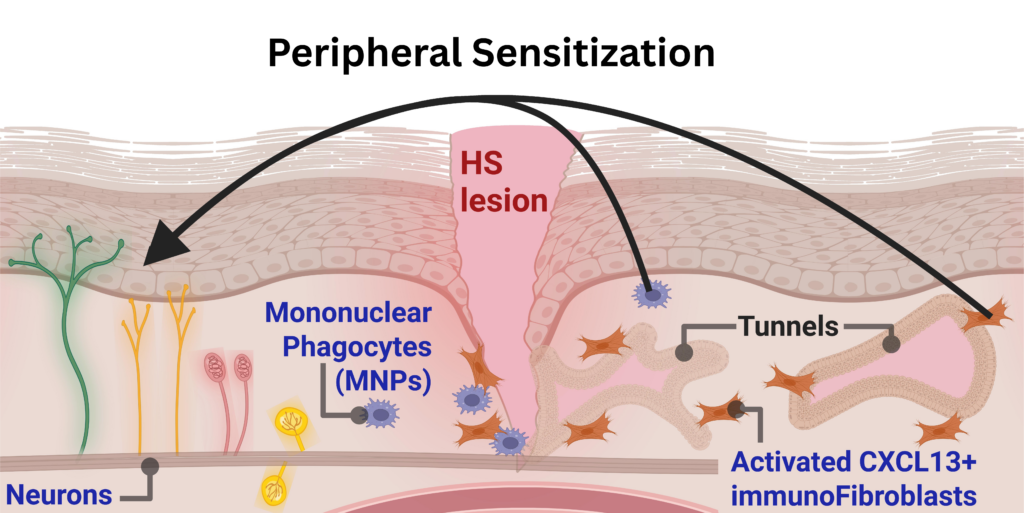
Pain is a key symptom in hidradenitis suppurativa (HS) and up to one-third of patients use cannabis. Despite this clinical signal, the endocannabinoid system (ECS) and molecular nociceptive networks remain essentially uncharacterized. Transcriptomic comparisons between HS patients and healthy controls were conducted utilizing bulk RNA-seq (blood and skin) alongside cutaneous scRNA-seq. A curated 134-gene panel mapped the peripheral nociceptive network, encompassing neurotrophic and immune signaling, extracellular matrix remodeling, and bioactive lipid mediators. Compared with healthy controls, bulk transcriptomic profiling of HS patients revealed nine ECS-related genes differentially expressed in lesional skin and eight in the blood. Additionally, seven distinct bioactive lipid mediator genes were dysregulated within HS lesions, suggesting a lesion-level shift in prostaglandin, thromboxane, and leukotriene biosynthesis. At single-cell resolution, of the five major cell populations analyzed, keratinocytes and T cells played a relatively minor role in the broader pain signature. In contrast, mononuclear phagocytes (MNPs) and fibroblasts emerged as central cellular amplifiers of peripheral nociception. MNPs significantly dysregulated 48 panel genes, including the biosynthetic machinery for nociceptive lipid mediators across the endocannabinoid, prostaglandin, leukotriene, and thromboxane axes. Moreover, MNPs amplify pain networks by inducing pronociceptive chemokines, cytokines, alarmins, neuropeptides, mechanotransducers, and matrix-remodeling proteases, a shift potentiated by substantial hypoxic and oxidative adaptations. Fibroblasts exhibited a broad transcriptomic shift altering 46 pain-network genes, dysregulating matrix-remodeling, inflammatory, and lipid mediator pathways. Critically, the alteration of neurotrophic factors, plasminogen activators, and axon guidance molecules suggest a permissive environment for disorganized hyperinnervation. Furthermore, the sensory ion channel TRPA1 emerged as a significantly upregulated stromal sensor, with this entire nociceptive signature correlating with CXCL13-positive immunofibroblasts. Additionally, leveraging the high B cell density in HS lesions enabled a novel intratissue trajectory analysis, revealing constitutive lipid mediator expression without significant transcriptomic shifts across memory, plasmablast, and plasma cell maturation stages. Finally, in silico intersection of this pathogenic profile with the druggable proteome identified precision therapeutic candidates, encompassing targetable GPCRs, FDA-approved monoclonal antibodies against inflammatory nodes, and experimental sphingolipid and leukotriene cascade inhibitors. Collectively, this study establishes the first systematic transcriptomic map of the peripheral nociceptive network and endocannabinoidome in hidradenitis suppurativa, providing both a mechanistic framework for disease-associated nociception and a biological rationale for targeted therapeutic intervention.
Regulatory Disclaimer: The scientific manuscripts, mathematical models, and biological frameworks presented written by me (the deterministic models of inflammatory flux, macroscopic behavioral feedback networks, and single-cell transcriptomic analyses) are theoretical and educational constructs. These frameworks are designed to visualize biophysical principles, psychosocial dynamics, and proposed mechanisms of the disease. The equations, graphical abstracts, and all data provided are intended strictly for academic elucidation and do not constitute medical advice.
Important Medical Disclaimer
1. Not Medical Advice: All content and information on this website is for informational and educational purposes only. It does not constitute medical advice and is not a substitute for professional diagnosis, treatment, or consultation with a qualified healthcare provider.
2. My Role and Qualifications: I am a biomedical scientist who has completed the academic requirements for a PhD, and I share information from this perspective, combined with my personal experience as a patient with Hidradenitis Suppurativa. However, I am not a medical doctor or registered healthcare professional. Do not consider our relationship a doctor-patient relationship.
3. Consult Your Doctor: Always seek the advice of your medical doctor or another qualified health professional with any questions you may have regarding a medical condition. Never disregard professional medical advice or delay seeking it because of something you have read on this website. If you suspect you are experiencing a medical emergency, or a severe infection, do not rely on this website or the HS Arma community, please call your local emergency services or go to the nearest emergency room immediately.
4. A Critical Warning on Medication: Pharmaceutical drugs are a crucial tool in managing Hidradenitis Suppurativa for many people. Under absolutely no circumstances should you ever alter, reduce, or stop taking your prescribed medication without the explicit direction of the doctor who prescribed it. Doing so can be dangerous. Always consult with your doctor before doing anything related to your treatment plan.
5. No Liability: Your use of this website and reliance on any information provided is solely at your own risk.
6. Individual Results May Vary: Every patient’s biological baseline, genetics, and adherence to the protocol is different. Therefore, I cannot guarantee specific results.