

My name is Jaap, and I am a biomedical scientist that also used to live with severe Hidradenitis Suppurativa, the kind that takes over your life. Today, I am completely asymptomatic because I learned how to heal Hidradenitis Suppurativa from within. More importantly, I’ve had the privilege of helping many other individuals with HS get their lives back too.
Unlocking the Past: A 192-Year-Old Clue to Treating HS Naturally
For centuries, if you suffered from painful, recurring boils in your armpits or groin, your condition was simply dismissed. It was just another common abscess, another infection. That was the tough reality for countless people… until one surgeon in 1839 became the first to formally describe it as something unique he had never seen before.
A Proven natural Roadmap to Manage HS
Get the support and natural strategies you need for lasting relief and join a community that understands.

A historically significant entry in a French medical encyclopedia from 1833. The author index on the left lists the surgeon Alfred Velpeau and his chapter on the “Aisselle” (armpit), which contained the first detailed clinical description of the disease now known as hidradenitis suppurativa. The page is part of the book’s dual index system, which includes this author index and an alphabetical subject index (right).
Diving into the history of Hidradenitis Suppurativa isn’t just a fun history lesson. I believe it teaches us a ton about the core nature of this disease. It gives us powerful clues about how to treat hidradenitis suppurativa by understanding its most fundamental characteristics. When we look at these origins through the lens of modern science, a new picture of hope begins to emerge.
A Disease Without a Name
Before 1833, having what we now call HS meant you were completely misunderstood. Doctors had no framework to distinguish your condition from a simple infection. The suffering was immense, and the feeling of being misunderstood was just as painful as the physical symptoms. So many HS patients around the world are still suffering immensely from this disease, and that feeling of being misunderstood, sadly, hasn’t gone away.
In 1833, a French surgeon named Alfred-Armand-Louis-Marie Velpeau made a critical observation. While contributing to a medical dictionary, he wrote something revolutionary in the entry for ‘Aisselle’—the French word for ‘armpit’.
A Proven natural Roadmap to Manage HS
Get the support and natural strategies you need for lasting relief and join a community that understands.

He described an inflammation he believed had never been documented. He gave it a name: ‘phlegmon tubériforme,’ which essentially means a nodule-like (‘tuberiform’) and spreading (‘phlegmon’) inflammation.
Let’s look at his exact words from the original text:
“There exists in the hollow of the armpits an inflammation that I do not believe has been described to this day, and that I will name tuberiform phlegmon, a kind of deep swelling, not very painful, and excessively slow in its progression, which almost always ends in suppuration, but which is susceptible to healing only with great difficulty.”
It’s pretty amazing how well he documented this, right? But I know the first thing that jumps out to any HS warrior reading this: “not very painful.”
We all know this disease can cause pain that is beyond what a person should ever have to endure. So let’s tackle that head-on.
Decoding the Past: What Velpeau’s Words Tell Us About the Natural Treatment of HS
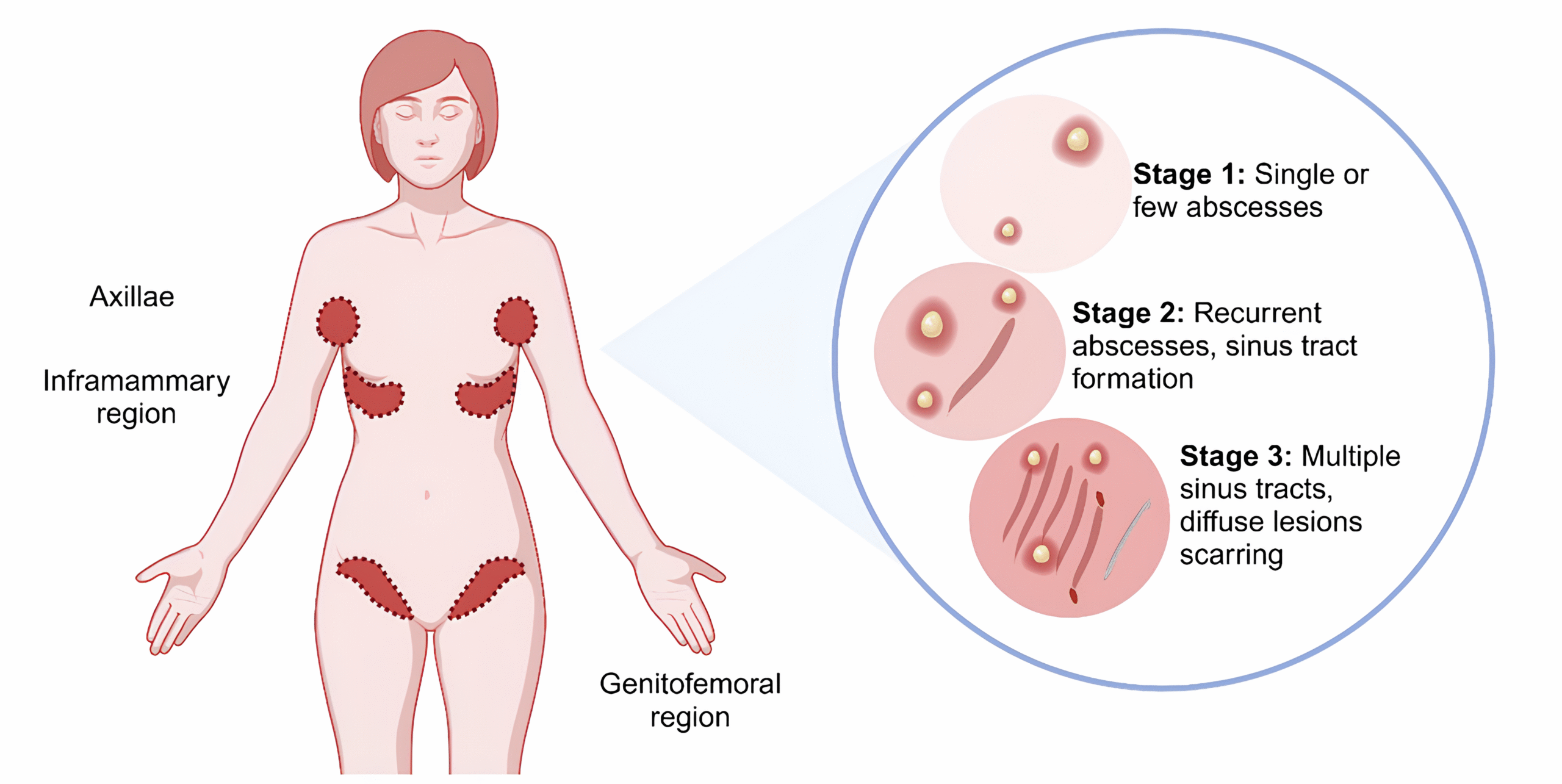
It’s highly likely that the cases Velpeau was observing were what we now call Hurley Stage I. In this initial stage, the lesions can show up as deep, hardened nodules that aren’t yet acutely painful. His description fits this perfectly.
Now, here’s a thought—and while it’s speculative, it’s fascinating to consider. Could the lifestyle of the 1830s have played a role? People ate whole, unprocessed foods. They lived far less sedentary lives. It’s possible these environmental factors kept the disease from progressing to the more severe, agonizingly painful stages we so often see today.
A Proven natural Roadmap to Manage HS
Get the support and natural strategies you need for lasting relief and join a community that understands.

This brings us to a crucial point. Modern medicine often describes HS as a “chronic, progressive disease.” This means it’s expected to worsen over time without intervention. Unfortunately, the underlying predisposition is for life.
But the most important message i can share is that does not mean progression is inevitable.
I firmly believe, based on both research and experience, that the disease is fully controllable. This is a core principle we put into practice every day in the HS Arma community. The goal isn’t a magic pill, but to keep the disease in Stage I by managing its underlying drivers. We do this through precise nutritional and lifestyle strategies, supported by natural therapies that promote healing from within and at the skin level. Seeing how these changes have helped so many in our community really brings this research to life.
A Remarkable Description of HS
When you see Velpeau’s description as a perfect portrait of Hurley Stage I, his words are shockingly accurate. Let’s break it down:
- ‘Tuberiform phlegmon’: He was describing a nodule-like (‘tuberiform’) and spreading (‘phlegmon’) inflammation. Spot on.
- ‘A kind of deep swelling’: Modern science tells us this is exactly right. An HS lesion starts when a hair follicle gets blocked and ruptures, spilling its contents into the dermis (the second layer of skin). The body sees this as a foreign invader and launches a massive immune response, causing that deep swelling.
- ‘Excessively slow in its progression’: Every single person with HS knows this feeling. A flare-up doesn’t just vanish in a day or two. It can linger for weeks, months, or even become permanent if not addressed.
- ‘Almost always ends in suppuration’: “Suppuration” is just a medical term for forming pus. This happens when the immune battle becomes so intense that cells die off, creating the pus characteristic of an HS flare.
- ‘Susceptible to healing only with great difficulty’: This is perhaps his most powerful statement. Managing HS is a a fight for your life and well-being. It’s not easy, and there isn’t a lot of room for error.
A Proven natural Roadmap to Manage HS
Get the support and natural strategies you need for lasting relief and join a community that understands.

He added even more detail, describing the nodules as “scirrhous kernels or multiple, hardened glands.” “Scirrhous” was an old term for a hard, fibrous tumor, and it was his way of saying how hard these nodules felt under the skin. As a researcher, I can tell you a Stage I nodule can feel exactly like a small, hardened gland—I’ve felt the adrenal glands of mice, rats, pigs, and cows during my academic career in biomedical research. It’s a strange but incredibly accurate comparison.
He correctly noted they “develop in the cellular tissue, under the skin,” confirming this is a deep inflammatory process, not a superficial one.
Why This History Matters for Your Healing Journey
To be clear, Velpeau didn’t understand why this was happening. He never mentioned hair follicles, the immune system, or apocrine glands. That knowledge would come decades later from others like Aristide Verneuil.
But Velpeau’s contribution was a work of pure, brilliant clinical observation. He gave the medical community the language and the framework to finally see HS as a unique condition. He started the long, difficult fight for correct diagnosis and recognition, a fight we are all still part of today.
Understanding this history reinforces a critical truth: HS is not a simple skin issue. It has a complex, distinct pathology that requires a targeted, comprehensive approach. And thankfully, that’s what the medical community is slowly catching up to today.
A Proven natural Roadmap to Manage HS
Get the support and natural strategies you need for lasting relief and join a community that understands.

Key Takeaways
- A Disease Finally Named: In 1833, surgeon Alfred Velpeau was the first to describe HS as a unique disease, calling it ‘phlegmon tubériforme’.
- A Portrait of Stage I: His description of a deep, slow-moving, and “not very painful” swelling perfectly matches what we now call Hurley Stage I HS.
- Progression Isn’t Inevitable: While HS is considered a chronic, progressive disease, its progression can be controlled. Managing the underlying drivers with a natural treatment of HS approach focused on nutrition and lifestyle can keep the disease in its earliest, most manageable stage.
- A Deeper Approach is Needed: Velpeau’s work highlights that HS has always been a complex, deep-seated inflammatory condition, not a superficial skin problem.
Conclusion
So, can you cure HS? In the sense of making the genetic predisposition disappear forever, the answer is currently no. But can you control it? Can you put it into remission and keep it there? Absolutely. Some clues were there right from the beginning, in the very first description of the disease. Velpeau saw a condition that was difficult to heal, but his observations and all the research that followed now empower us to take a smarter approach. We can stop the progression. We can get our lives back.
A Proven natural Roadmap to Manage HS
Get the support and natural strategies you need for lasting relief and join a community that understands.

Important Medical Disclaimer
1. Not Medical Advice: All content and information on this website is for informational and educational purposes only. It does not constitute medical advice and is not a substitute for professional diagnosis, treatment, or consultation with a qualified healthcare provider.
2. My Role and Qualifications: I am a biomedical scientist and PhD candidate and share information from that perspective, combined with my personal experience as a patient with Hidradenitis Suppurativa. However, I am not a medical doctor, physician, or registered healthcare professional. Do not consider our relationship a doctor-patient relationship.
3. Consult Your Doctor: Always seek the advice of your medical doctor or another qualified health professional with any questions you may have regarding a medical condition. Never disregard professional medical advice or delay seeking it because of something you have read on this website. If you suspect you are experiencing a medical emergency, or a severe infection, do not rely on this website or the HS Arma community, please call your local emergency services or go to the nearest emergency room immediately.
4. A Critical Warning on Medication: Pharmaceutical drugs are a crucial tool in managing Hidradenitis Suppurativa for many people. Under absolutely no circumstances should you ever alter, reduce, or stop taking your prescribed medication without the explicit direction of the doctor who prescribed it. Doing so can be dangerous. Always consult with your doctor before doing anything related to your treatment plan.
5. No Liability: Your use of this website and reliance on any information provided is solely at your own risk.
6. Individual Results May Vary: Every patient’s biological baseline, genetics, and adherence to the protocol is different. Therefore, I cannot guarantee specific results, cures, or timelines for your Hidradenitis Suppurativa.
7. Scientific and Expressive Freedom: The articles published on this blog are distinct from formal peer-reviewed academic literature. They serve as an independent platform for my personal viewpoints, scientific hypotheses, and philosophical reflections as an independent scientist and HS patient. While grounded in biomedical research, I exercise a degree of expressive freedom to translate rigid academic data into insights from a patient perspective. These writings are my personal meditations on the science of HS and should be read as my individual perspective, not as universally accepted clinical consensus or formal peer-reviewed literature.