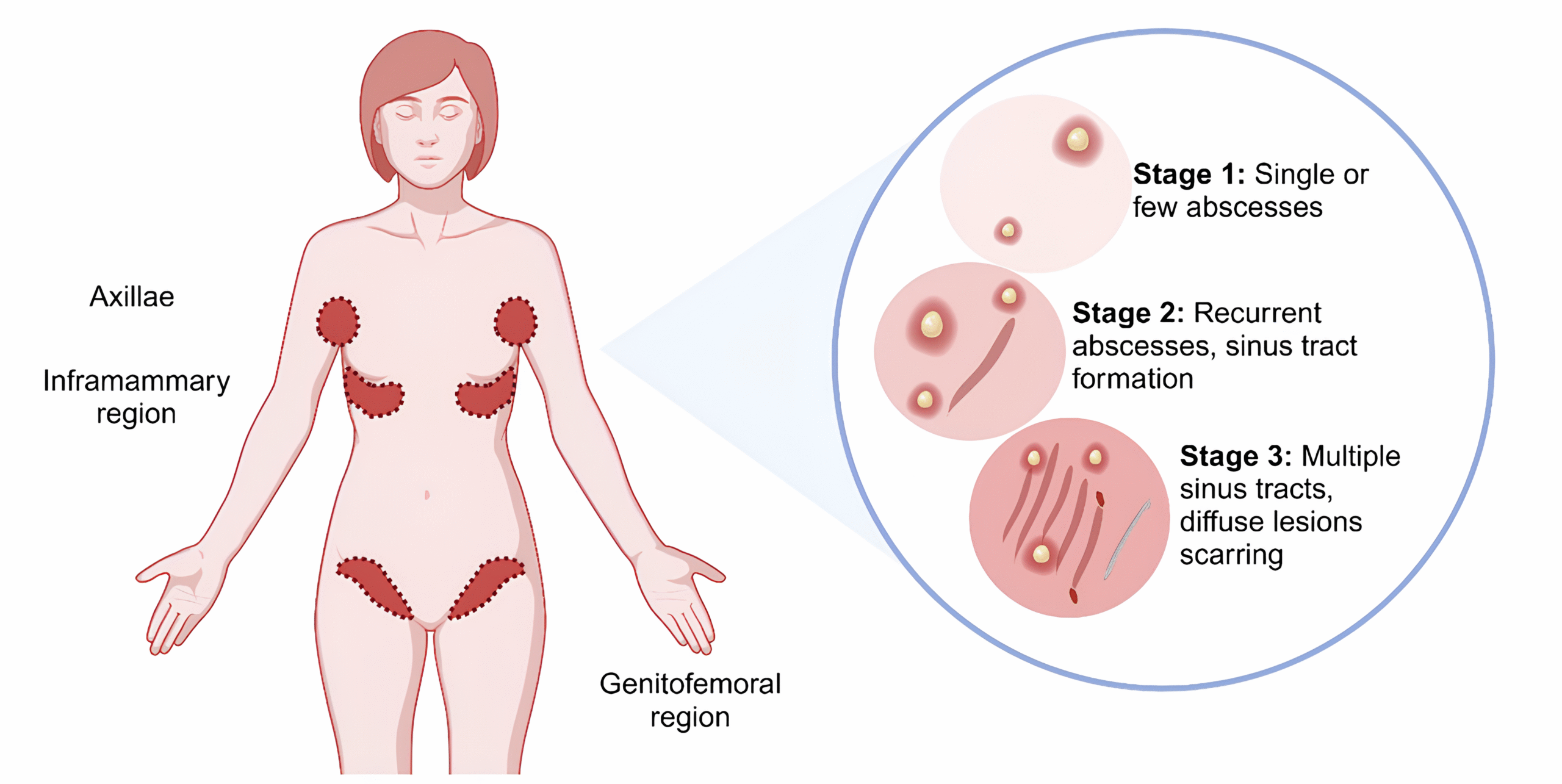

My name is Jaap, and I am a biomedical scientist that also used to live with severe Hidradenitis Suppurativa, the kind that takes over your life. Today, I am completely asymptomatic because I learned how to heal Hidradenitis Suppurativa from within. More importantly, I’ve had the privilege of helping many other individuals with HS get their lives back too.
A Proven natural Roadmap to Manage HS
Get the support and natural strategies you need for lasting relief and join a community that understands.

The Fire Within: Unpacking the Engine of Your HS Flares
If you have Hidradenitis Suppurativa (HS), you know the feeling all too well. It’s not just a boil or a cyst. It’s a deep, painful, radiating heat that feels like a fire is brewing under your skin. For years, we’ve been told it’s just “inflammation,” a vague and unhelpful term. But what if I told you that scientists are now mapping the exact molecular engine that creates that fire? And that understanding this engine gives us the blueprint for how to treat Hidradenitis Suppurativa from the inside out?
A brilliant new review paper from Dr. Ciara Campbell and her team has shed light on a critical piece of the HS puzzle: a group of proteins called inflammasomes. Think of them as the fire alarm and the sprinkler system for your cells, all in one. They are absolutely essential for a healthy immune response. But in HS, this system goes haywire.
In this post, we’re going to dive into this groundbreaking research. We’ll explore what these inflammation engines are, how they drive the painful cycle of HS lesions, and most importantly, what this science means for the natural treatment of HS. This isn’t just about managing symptoms; it’s about understanding the root cause so we can finally put out the fire for good.
From Clogged Follicle to Firestorm: The Three-Act Tragedy of an HS Lesion
Before we get into the microscopic details, let’s zoom out. The researchers provide a fantastic overview of HS pathogenesis, the journey from a seemingly normal hair follicle to a full-blown, painful lesion. I see it as a three-act tragedy, and the inflammasome is the star of the show in Act II and III.
Act I: The Occlusion. It all starts with a process called hyperkeratinization. This is a fancy way of saying the skin cells in the upper part of the hair follicle grow too much and too quickly. This buildup creates a plug, trapping bacteria, oil (sebum), and cellular debris inside. The follicle starts to swell like a water balloon that’s been overfilled. This is the calm before the storm.
A Proven natural Roadmap to Manage HS
Get the support and natural strategies you need for lasting relief and join a community that understands.

Act II: The Rupture. The pressure builds until the follicle wall can’t take it anymore. It ruptures, spilling its entire contents, bacteria, keratin, sebum, and fragments of our own dead cells, into the deeper layers of the skin (the dermis).
Act III: The Inflammasome Activation. This is the critical moment. Your immune cells, particularly macrophages (the guard cells of your body), sense this sudden spill. They don’t see keratin or cell debris; they see DAMPs (Damage-Associated Molecular Patterns). They see the bacteria as PAMPs (Pathogen-Associated Molecular Patterns). To your immune system, these are unequivocal DANGER signals.
In response, these immune cells activate their inflammasome engines. As you can see in Figure 1, this triggers a massive inflammatory response. The inflammasome activates a protein called caspase-1, which in turn switches on one of the most powerful inflammatory messengers in the body: Interleukin-1 beta (IL-1β).
IL-1β is the fire alarm that rings loud and clear, screaming, “EMERGENCY!” It calls in an army of other immune cells (like neutrophils and T-cells), creating the pus, swelling, and intense pain of an HS abscess. This creates a vicious cycle, leading to more tissue damage, more DAMPs, and the formation of the sinus tracts and tunnels that are characteristic of later hidradenitis suppurativa stages.
A Proven natural Roadmap to Manage HS
Get the support and natural strategies you need for lasting relief and join a community that understands.
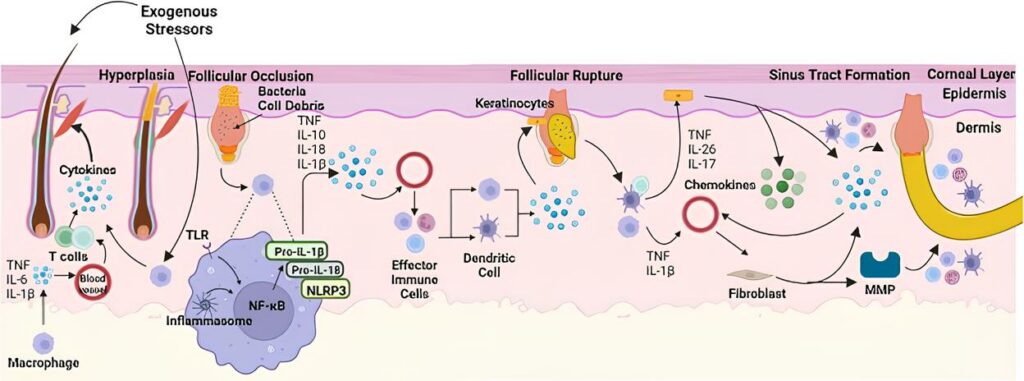
Figure 1: The Vicious Cycle of an HS Lesion. This diagram illustrates the step-by-step progression of Hidradenitis Suppurativa, from a healthy hair follicle to a painful, inflamed lesion. Let’s walk through it in more detail, following the image from left to right. Figure by Dr. Ciara Campbell and team
- (Hyperplasia & The First Responders): It begins with exogenous stressors (our lifestyle/dietary triggers) causing the hair follicle lining to thicken (Hyperplasia). This initial stress activates resident immune cells. On the far left, you see a Macrophage releasing inflammatory signals (Cytokines) like TNF, IL-6, and IL-1β. These signals recruit other immune cells, like T-cells, from the blood vessels.
- (Follicular Occlusion & Priming the Inflammasome): The follicle becomes plugged with bacteria and cell debris. The initial inflammation has now primed the area for a bigger reaction. A large Macrophage (the big purple cell) is shown sensing these danger signals through its Toll-Like Receptors (TLRs). This activates a key internal switch, NF-κB, which prepares the cell to build the NLRP3 inflammasome and produce pro-inflammatory molecules (Pro-IL-1β and Pro-IL-18).
- (Follicular Rupture & The Firestorm): The follicle ruptures. Its contents spill out and are detected by other immune cells. Keratinocytes (skin cells) and Dendritic Cells (messenger immune cells) are activated. This triggers the release of a second wave of powerful signals, including Chemokines, which are like a GPS signal calling for reinforcements.
- (Immune Cell Recruitment & Tissue Damage): The chemokines create an inflammatory storm, attracting a flood of immune cells. This leads to the release of more TNF and now IL-17 and IL-26. This environment activates Fibroblasts, which start producing Matrix Metalloproteases (MMPs), enzymes that literally dissolve the surrounding tissue. This is what creates the tunnels.
- (Sinus Tract Formation): The end result of this sustained, destructive cycle is the formation of a Sinus Tract, a permanent tunnel under the skin. The process of inflammation, rupture, and tissue destruction is now locked in a self-perpetuating loop, fueling the chronic nature of HS.
Under the Hood: A Closer Look at the NLRP3 Engine
So, what is this inflammasome, really? The paper highlights one in particular that is a key player in HS: the NLRP3 inflammasome. Figure 2 gives us a detailed, but very complex, look at its inner workings. Don’t worry, you don’t need a PhD to understand the core idea.
Think of activating NLRP3 like launching a missile: it requires a two-key system for safety.
- Key #1 (Priming): First, the system needs to be armed. This happens when your cells are exposed to a low-level inflammatory signal, like TNF-α (a molecule many HS biologics target) or bacterial components like LPS. This “priming” step gets all the parts of the inflammasome machinery built and ready to go.
- Key #2 (Activation): The second key turns and launches the missile. This requires a specific “danger” signal, like the cellular debris (DAMPs) released during follicular rupture. This signal causes all the pre-built parts to assemble into the final, active inflammasome complex.
Once assembled, NLRP3 does its job: it activates caspase-1, which chops up pro-IL-1β into its active, fiery form. The result? A massive inflammatory response.
A Proven natural Roadmap to Manage HS
Get the support and natural strategies you need for lasting relief and join a community that understands.
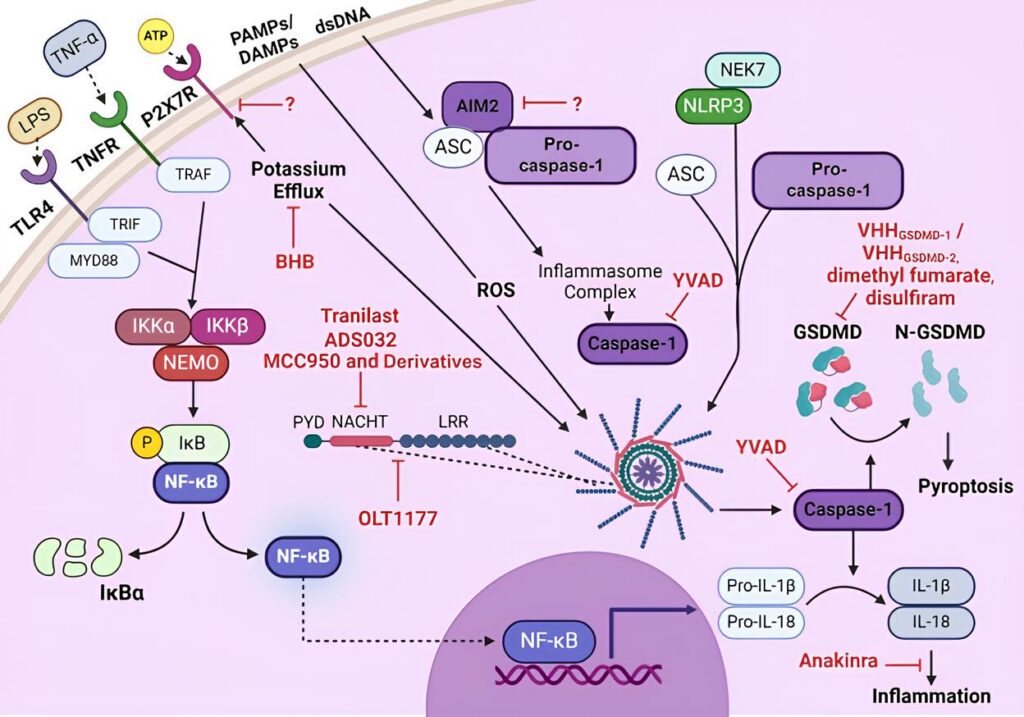
Figure 2: The Blueprint of the NLRP3 Inflammasome Engine and Its Off-Switches. This diagram looks complex, but it’s essentially a wiring diagram for the main inflammation engine in HS. Figure by Dr. Ciara Campbell and team
- (Priming – Arming the System): On the left, you see signals like LPS (from bacteria) and TNF-α hitting receptors on the cell surface. This triggers a pathway (involving proteins like MYD88 and NF-κB) that acts as the first safety check. It tells the cell’s nucleus to start producing the inactive building blocks of the inflammasome and pro-IL-1β. The system is now “primed” and ready.
- (Activation – Turning the Key): Next, a second danger signal is needed. This can be things like cellular debris (PAMPs/DAMPs) or a flood of ATP from dying cells. This triggers the assembly of the NLRP3 inflammasome complex (the star-shaped structure in the center).
- (The Final Cascade): The assembled inflammasome activates caspase-1. This activated enzyme does two key things: 1) It cleaves pro-IL-1β and pro-IL-18 into their active forms, which are then released to cause widespread inflammation. 2) It cleaves a protein called Gasdermin D (GSDMD), which punches holes in the cell membrane, causing a fiery type of cell death called pyroptosis.
- (Therapeutic Targets – Cutting the Wires): The red text shows where different drugs and compounds can interrupt this process. Some, like MCC950, block the assembly of the inflammasome itself. Others, like Anakinra, block the IL-1β signal after it’s been released. This highlights the downstream approach of many pharmaceuticals.
A Proven natural Roadmap to Manage HS
Get the support and natural strategies you need for lasting relief and join a community that understands.

The Knowledge Gap: Where Drugs Stop and True Healing Begins
The most exciting part of this research, from a conventional perspective, is that it provides a detailed map of new potential drug targets. As you can see in Figure 2, scientists are developing drugs (like MCC950 and others) that can jam the NLRP3 engine at different points, preventing it from releasing its inflammatory payload. This is a huge step forward and offers hope for better treatments.
But here’s my core critique. This is still a downstream solution. It’s like discovering a new, better way to turn off the fire alarm… without ever asking what’s causing the fire.
This is the knowledge gap where the HS Arma philosophy comes in. We must ask the deeper question: Why are our bodies sending so many DANGER signals in the first place?
The triggers for HS, the exogenous stressors mentioned in Figure 1, aren’t just abstract concepts. They are the inflammatory foods in ourdiet, the chronic stress in our lives, the poor sleep that prevents our cells from repairing, and the environmental toxins we’re exposed to. These are the things that create the DAMPs and PAMPs that are turning on the inflammasome engine 24/7.
Conventional medicine views drugs as the main treatment, with lifestyle as a small, optional add-on. We at HS Arma reverse this. We focus on highly effective, evidence-based nutrition and lifestyle change, and natural therapies and practices. For us, this foundational work is the main treatment. Pharmaceuticals are a powerful, temporary shield, sometimes necessary to control a raging fire, but they don’t rebuild the house. The goal is to build such a strong foundation of health that these shields become less necessary, or ideally, completely unnecessary. This is the core principle we put into practice every day in our community.
A Proven natural Roadmap to Manage HS
Get the support and natural strategies you need for lasting relief and join a community that understands.

Key Takeaways
For those of you skimming, here are the most important points:
- HS inflammation isn’t random. It’s driven by specific molecular engines called inflammasomes, with NLRP3 being a key player.
- These engines are activated by danger signals that are released when a hair follicle ruptures, creating a vicious cycle of inflammation, pain, and tissue damage.
- The primary output of this engine is IL-1β, a powerful molecule that orchestrates the painful HS flare.
- While new drugs are being designed to block this engine, the most powerful, long-term strategy is to address the root cause. A natural treatment of HS focuses on reducing the dietary and lifestyle triggers that send these danger signals in the first place.
Conclusion: You Are the Architect of Your Own Healing
This research is more than just a fascinating look at our biology. It is a message of profound hope. For the first time, we can see the exact machinery behind our pain. And when you can see the machine, you can learn how to influence it.
So, can you cure HS? While you can be cured, you absolutely can achieve lasting remission. You can turn down the activity of these inflammatory pathways. You can heal. This science empowers us to move beyond fear and helplessness and become the architects of our own health. By focusing on the upstream causes, the food we eat, the way we live, the stress we manage, we can quiet the danger signals and give our bodies the chance to finally find balance.
A Proven natural Roadmap to Manage HS
Get the support and natural strategies you need for lasting relief and join a community that understands.

References
- Campbell, C., Mayatra, J. M., Neve, A. J., Fletcher, J. M., & Johnston, D. G. (2024). Inflammasomes: emerging therapeutic targets in hidradenitis suppurativa?. British Journal of Dermatology, 191(5), 670–679.
- Danby, F. W., Maddison, J., & Jemec, G. B. (2020). Diet in hidradenitis suppurativa: a review. Dermatologic clinics, 38(1), 83-91.
- Sabat, R., Jemec, G. B., Matusiak, L., Kimball, A. B., & Prens, E. (2020). Hidradenitis suppurativa. Nature reviews Disease primers, 6(1), 18.
- Moran, B., Smith, C. M., Zabarowski, A., Kanny, G., Jones, J., & Fletcher, J. M. (2023). Targeting the NLRP3 inflammasome reduces inflammation in hidradenitis suppurativa skin. British Journal of Dermatology, 189(4), 447-458.
Important Medical Disclaimer
1. Not Medical Advice: All content and information on this website is for informational and educational purposes only. It does not constitute medical advice and is not a substitute for professional diagnosis, treatment, or consultation with a qualified healthcare provider.
2. My Role and Qualifications: I am a biomedical scientist and PhD candidate and share information from that perspective, combined with my personal experience as a patient with Hidradenitis Suppurativa. However, I am not a medical doctor, physician, or registered healthcare professional. Do not consider our relationship a doctor-patient relationship.
3. Consult Your Doctor: Always seek the advice of your medical doctor or another qualified health professional with any questions you may have regarding a medical condition. Never disregard professional medical advice or delay seeking it because of something you have read on this website. If you suspect you are experiencing a medical emergency, or a severe infection, do not rely on this website or the HS Arma community, please call your local emergency services or go to the nearest emergency room immediately.
4. A Critical Warning on Medication: Pharmaceutical drugs are a crucial tool in managing Hidradenitis Suppurativa for many people. Under absolutely no circumstances should you ever alter, reduce, or stop taking your prescribed medication without the explicit direction of the doctor who prescribed it. Doing so can be dangerous. Always consult with your doctor before doing anything related to your treatment plan.
5. No Liability: Your use of this website and reliance on any information provided is solely at your own risk.
6. Individual Results May Vary: Every patient’s biological baseline, genetics, and adherence to the protocol is different. Therefore, I cannot guarantee specific results, cures, or timelines for your Hidradenitis Suppurativa.
7. Scientific and Expressive Freedom: The articles published on this blog are distinct from formal peer-reviewed academic literature. They serve as an independent platform for my personal viewpoints, scientific hypotheses, and philosophical reflections as an independent scientist and HS patient. While grounded in biomedical research, I exercise a degree of expressive freedom to translate rigid academic data into insights from a patient perspective. These writings are my personal meditations on the science of HS and should be read as my individual perspective, not as universally accepted clinical consensus or formal peer-reviewed literature.