
My name is Jaap, and I am a biomedical scientist that also used to live with severe Hidradenitis Suppurativa, the kind that takes over your life. Today, I am completely asymptomatic because I learned how to heal Hidradenitis Suppurativa from within. More importantly, I’ve had the privilege of helping many other individuals with HS get their lives back, too.
A Proven natural Roadmap to Manage HS
Get the support and natural strategies you need for lasting relief and join a community that understands.

Introduction: The Surgeon’s Challenge and the Patient’s Hope
If you’ve battled Hidradenitis Suppurativa (HS) in your armpits, you know the devastation it can cause. The painful nodules and draining tunnels can make simple movements agonizing, leaving behind significant scarring. For many facing moderate to severe hidradenitis suppurativa stages (like Hurley Stage II or III), medical treatments sometimes fall short, and surgery becomes a serious consideration. The challenge for surgeons is significant: removing all the diseased tissue often results in challenging defects. Finding the right hidradenitis suppurativa treatment, especially surgically, is a constant balance between removing the problem and ensuring a good functional and cosmetic outcome.
Recently, I came across a study detailing a specific surgical technique designed for these challenging hidradenitis suppurativa armpit cases. Published in the Journal of Clinical Medicine, Dr. Andrzej Bieniek and his colleagues describe a method using preliminary defect closure combined with two triangular skin flaps [1]. First, my sincere thanks to Dr. Bieniek and the research team for sharing their work and contributing to the options available for managing severe HS. Their approach aims to be less invasive while still providing good coverage.
Today, let’s explore this technique. We’ll look at what the researchers did, what they found, and, crucially, place it within the larger context of healing HS. Because while surgery can be a powerful tool to deal with the damage caused by HS, we must always ask: does it address the underlying fire that caused the damage in the first place? Understanding this distinction is key to finding a path to lasting remission.
A Proven natural Roadmap to Manage HS
Get the support and natural strategies you need for lasting relief and join a community that understands.

A Closer Look: The Bieniek-Star Technique Explained
Dealing with the aftermath of removing diseased HS tissue in the armpit requires careful planning. Simply stitching the edges together often isn’t possible for medium-to-large defects and can lead to wounds reopening or healing poorly. Other options, like skin grafts, can result in scarring and contractures that limit arm movement. Flap surgery, where skin and underlying tissue are moved from a nearby area to cover the defect, offers better coverage but can be complex and invasive.
The technique described by Dr. Bieniek and colleagues, which builds on a previous “star technique”, tries to find a middle ground. Here’s a simplified breakdown of their approach for medium-sized axillary defects:
- Remove the Disease: All affected skin, subcutaneous tissue, and tunnels are surgically excised.
- Initial Reduction: Small triangles of skin are removed from the top and bottom edges of the wound. Stitching these small gaps closed helps to significantly shrink the size of the main defect. Think of it like gently gathering the edges of a hole before patching it.
- Dual Flap Coverage: Two triangular flaps, including skin and underlying fat, are carefully lifted, one from the inner side of the upper arm and one from the side of the chest. These flaps are designed as “island” flaps, meaning they stay connected to their blood supply underneath.
- Sliding Closure: The two triangular flaps are then slid towards the center of the remaining defect using a V-Y advancement technique (the incision looks like a V, and closing it forms a Y shape), covering the wound without tension, as shown in Figure 3.
The goal is effective wound closure with potentially less extensive dissection than some traditional flap methods. The images below, adapted from the paper, give a visual sense of the process and outcome.
A Proven natural Roadmap to Manage HS
Get the support and natural strategies you need for lasting relief and join a community that understands.
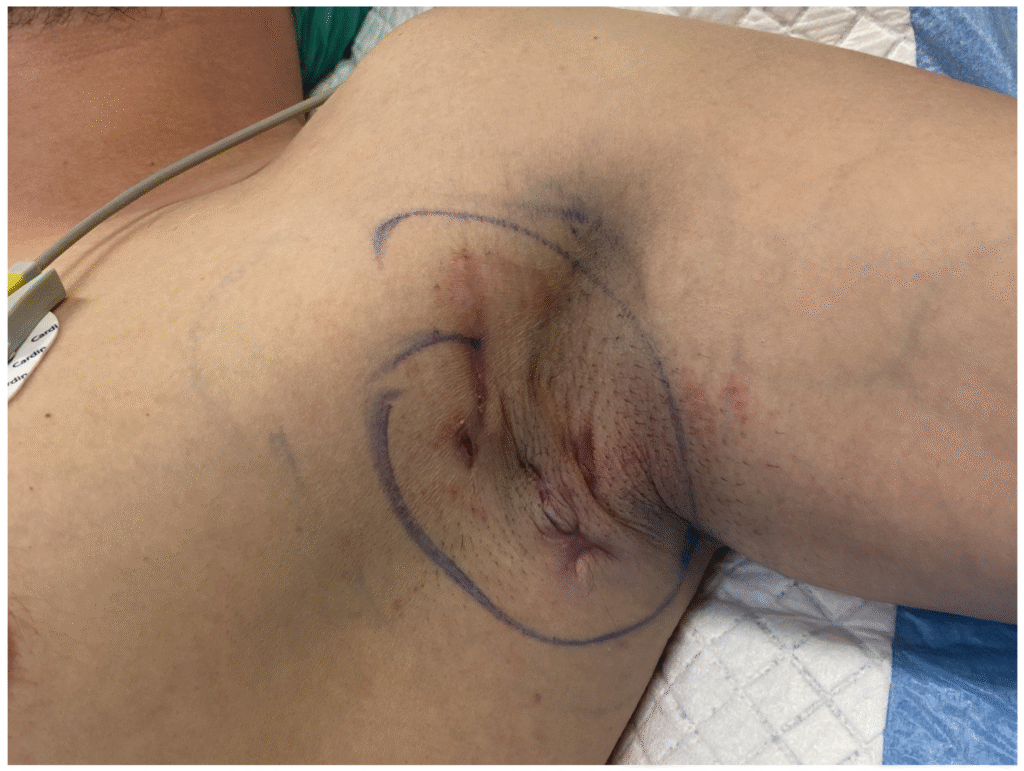
Figure 1 Legend: Preoperative view of the left axilla in a patient preparing for surgery using the Bieniek-star technique. This image shows the chronic inflammation and skin changes typical of Hurley stage II/III Hidradenitis Suppurativa before surgical intervention. Figure by Dr. Andrzej Bieniek and colleagues.
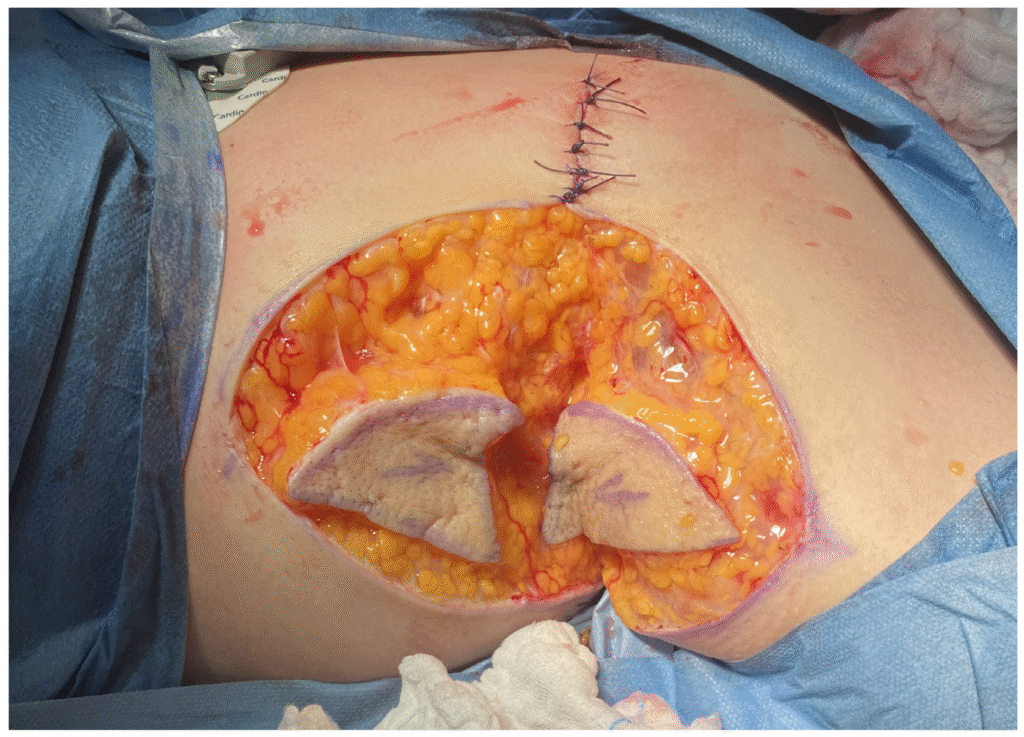
Figure 2 Legend: Mobilization of the two V-Y advancement triangular flaps during the Bieniek-star procedure. One flap is harvested from the inner arm and the other from the lateral chest wall. Both flaps, consisting of skin and subcutaneous fat, are carefully lifted while maintaining their underlying blood supply and are prepared to be advanced toward the center of the wound bed. Figure by Dr. Andrzej Bieniek and colleagues.
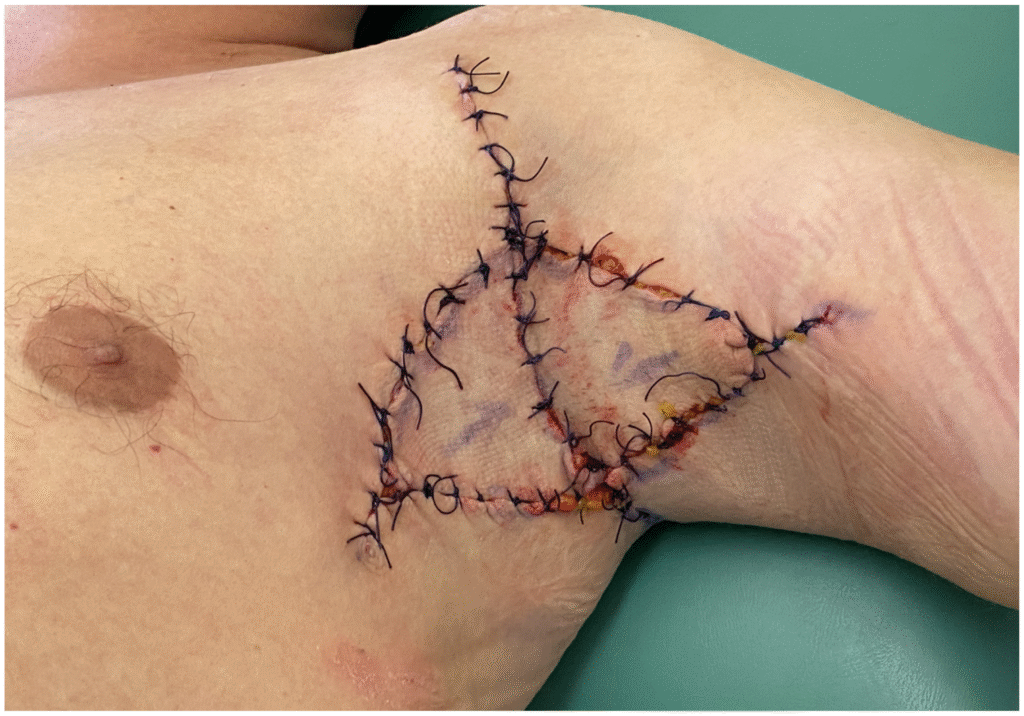
Figure 3 Legend: The final wound closure immediately after the Bieniek-star procedure. The two triangular flaps (one from the arm, one from the chest) have been advanced to meet in the center, covering the defect left after excision of the diseased tissue. Figure by Dr. Andrzej Bieniek and colleagues.
A Proven natural Roadmap to Manage HS
Get the support and natural strategies you need for lasting relief and join a community that understands.
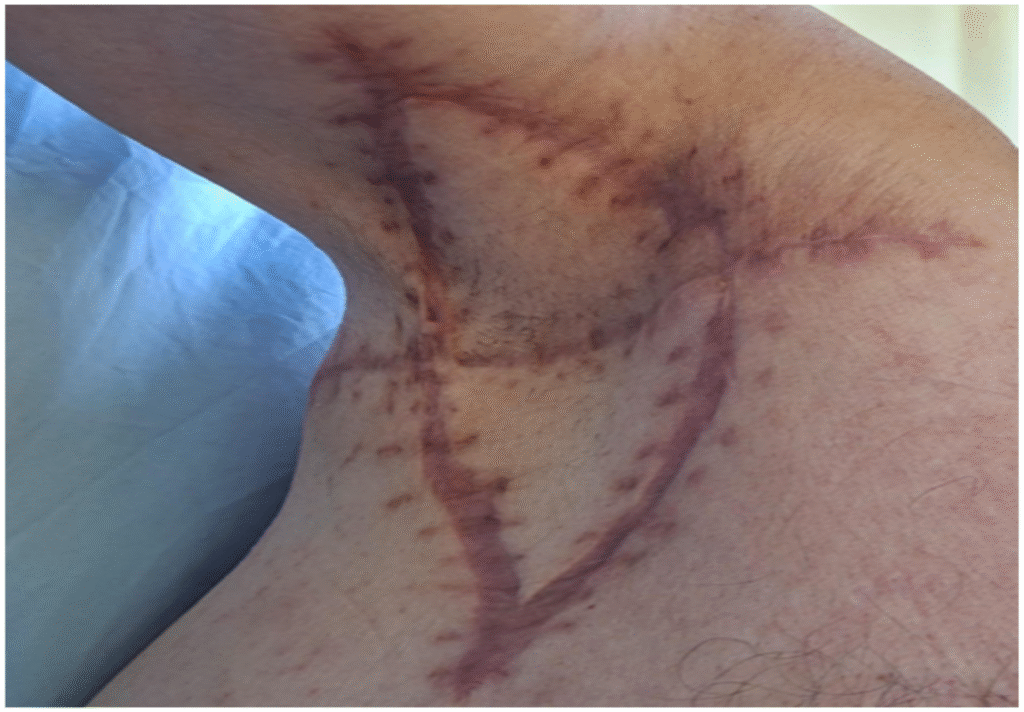
Figure 4 Legend: Six-month postoperative result following the Bieniek-star technique. The image shows complete healing of the surgical site with mature scar formation, illustrating the cosmetic outcome achievable with this flap reconstruction method. Figure by Dr. Andrzej Bieniek and colleagues.
What Did the Study Find? Promising Early Results
The researchers reported on 12 male patients, aged 21 to 53, with Hurley stage II or III HS affecting their axillae. The size of the affected areas ranged from 46 to 96 cm2. Here are the key outcomes observed over a six-month follow-up period:
- Good Healing: 11 out of 12 patients (91.7%) achieved good healing, defined as complete wound closure without infection or complications.
- Patient Satisfaction: 10 out of 12 patients (83.3%) reported being satisfied with the results.
- Cosmetic Results: Surgeons assessed the cosmetic outcome as good in 10 out of 12 cases (83.3%).
- Complications: No major complications like bleeding or flap failure were noted. Three patients (25%) experienced some scar tenderness.
- Recurrence: Only one patient (8.3%) experienced a recurrence of HS within the operated area at the six-month mark.
Based on these results, the authors conclude that their technique is a safe, effective, and cosmetically favorable option for medium-sized axillary HS defects, offering a less invasive alternative to some conventional flap surgeries. We should certainly thank Dr. Bieniek and his team for developing and sharing this advanced techniques, as improving surgical options is incredibly important for those facing the severe tissue damage caused by HS.
A Proven natural Roadmap to Manage HS
Get the support and natural strategies you need for lasting relief and join a community that understands.

The Knowledge Gap: Silencing the Alarm vs. Putting Out the Fire
This research is valuable, showcasing surgical innovation aimed at improving outcomes for patients needing tissue removal. The high healing rates and good cosmetic results are certainly encouraging signs. However, this is where we must zoom out and apply the core philosophy we practice at HS Arma, viewing this through the lens of addressing the root cause of Hidradenitis Suppurativa.
Surgery, no matter how skillfully performed, is a downstream intervention. It deals with the consequences of the disease, the damaged tissue, the tunnels, the chronic inflammation localized in that area. In our analogy, HS is like a fire raging deep inside your body (systemic inflammation), and the painful lesions are the smoke alarms blaring on the surface. Surgical excision is like expertly removing the burnt part of the wall and silencing that specific alarm. It provides relief in that area, and for someone suffering immensely, that relief is crucial and life-changing.
But surgery doesn’t put out the underlying fire. It doesn’t address the systemic immune dysregulation that caused the inflammation in the first place. This is the critical knowledge gap in relying solely on such approaches. The fire is still burning, which is why, even after successful surgery, HS can recur in the same area or appear in new locations. The 8.3% recurrence rate in this study at just six months, while relatively low, hints at this underlying reality. Longer-term studies often show higher recurrence rates after excision for HS.
A Proven natural Roadmap to Manage HS
Get the support and natural strategies you need for lasting relief and join a community that understands.

The HS Arma Philosophy: Building Health from the Foundation Up
This is why, at HS Arma, we reverse the conventional model. We see surgery and pharmaceuticals not as the primary solution, but as powerful temporary shields, tools that can be necessary to manage a crisis, reduce suffering, and remove irreversibly damaged tissue, giving you the space to do the real work of healing.
The foundational work, the path to lasting remission, lies in addressing the upstream causes. We focus on highly effective, evidence-based nutrition and lifestyle change, and natural therapies and practices designed to put out the systemic inflammatory fire. Our approach involves building your defenses, layer by layer:
- Foundational Nutrition: Identifying your personal inflammatory food triggers and nourishing your body with anti-inflammatory foods to calm the immune system at its source.
- Strategic Lifestyle Changes: Mastering stress, optimizing sleep, and reducing exposure to environmental toxins, all crucial for regulating immune responses.
- Natural Therapies & Skincare: Using targeted, science-backed natural compounds and supplements to help modulate inflammation and support skin healing from both inside and out.
- Accountability & Support: Providing the guidance and community connection needed to navigate this challenging journey successfully.
- Targeted Medical Testing: Empowering you with information to understand your unique biology and guide personalized interventions.
This research on surgical technique is important progress for managing the damage of HS. But it doesn’t change the fundamental truth: hidradenitis suppurativa causes are systemic. By understanding the science behind this specific surgery and placing it within the larger context of a root-cause approach, we can make more informed decisions about our own healing journey. The goal isn’t just to repair the damage, but to build a body where the fire doesn’t ignite in the first place.
It’s also important to note the limitations acknowledged by the study’s authors themselves: the small number of patients (12), the fact that all patients were male (preventing conclusions about females), the relatively short six-month follow-up (which may not capture later recurrences), and the potential for bias as surgeons assessed their own work.
A Proven natural Roadmap to Manage HS
Get the support and natural strategies you need for lasting relief and join a community that understands.

Key Takeaways
- New Advanced Surgical Option: The Bieniek-star technique offers a potentially less invasive flap surgery option for medium-sized axillary HS defects, showing good healing and cosmetic results in a small group of male patients.
- Surgery Addresses Damage, Not Cause: Surgical excision removes diseased tissue (the smoke damage) but doesn’t fix the underlying systemic inflammation (the “fire”) that drives HS.
- Recurrence is Possible: Even with successful surgery, HS can return because the root cause remains unaddressed. This study showed an 8.3% recurrence at 6 months.
- True Healing is Foundational: Lasting remission requires an “upstream” approach focused on putting out the inflammatory fire through evidence-based nutrition, lifestyle changes, and natural therapies.
Conclusion: Integrating Tools for a Holistic Path Forward
Surgical advancements like the Bieniek-star technique are valuable additions to the toolkit for managing the devastating physical consequences of Hidradenitis Suppurativa. For those suffering from extensive tissue damage in areas like the armpit, procedures like this can offer significant relief, improved function, and better quality of life.
However, we must see these tools for what they are: powerful ways to manage the results of the disease, not the cause. The answer to can you cure HS? doesn’t lie solely under the surgeon’s scalpel. True, sustainable healing (achieving lasting remission) requires us to look deeper, to address the systemic fire of inflammation from the inside out.
By integrating the best of medical and surgical interventions as necessary shields, while committing to the foundational work of rebuilding our health through a natural, root-cause approach, we can move beyond simply walking behind the damage HS leaves behind. We can work towards extinguishing the fire for good and reclaiming our lives. Healing naturally is possible.
A Proven natural Roadmap to Manage HS
Get the support and natural strategies you need for lasting relief and join a community that understands.

References
- Bieniek, A., Majda, F., Chlebicka, I., Knecht-Gurwin, K., & Szepietowski, J. C. (2025). Surgical Treatment of Axillary Hidradenitis Suppurativa Using Preliminary Defect Closure and Two Sliding Island Triangular Skin-Subcutaneous Flaps from the Arm and Chest. Journal of Clinical Medicine, 14(17), 5945. https://doi.org/10.3390/jcm14175945
Important Medical Disclaimer
1. Not Medical Advice: All content and information on this website is for informational and educational purposes only. It does not constitute medical advice and is not a substitute for professional diagnosis, treatment, or consultation with a qualified healthcare provider.
2. My Role and Qualifications: I am a biomedical scientist and PhD candidate and share information from that perspective, combined with my personal experience as a patient with Hidradenitis Suppurativa. However, I am not a medical doctor, physician, or registered healthcare professional. Do not consider our relationship a doctor-patient relationship.
3. Consult Your Doctor: Always seek the advice of your medical doctor or another qualified health professional with any questions you may have regarding a medical condition. Never disregard professional medical advice or delay seeking it because of something you have read on this website. If you suspect you are experiencing a medical emergency, or a severe infection, do not rely on this website or the HS Arma community, please call your local emergency services or go to the nearest emergency room immediately.
4. A Critical Warning on Medication: Pharmaceutical drugs are a crucial tool in managing Hidradenitis Suppurativa for many people. Under absolutely no circumstances should you ever alter, reduce, or stop taking your prescribed medication without the explicit direction of the doctor who prescribed it. Doing so can be dangerous. Always consult with your doctor before doing anything related to your treatment plan.
5. No Liability: Your use of this website and reliance on any information provided is solely at your own risk.
6. Individual Results May Vary: Every patient’s biological baseline, genetics, and adherence to the protocol is different. Therefore, I cannot guarantee specific results, cures, or timelines for your Hidradenitis Suppurativa.
7. Scientific and Expressive Freedom: The articles published on this blog are distinct from formal peer-reviewed academic literature. They serve as an independent platform for my personal viewpoints, scientific hypotheses, and philosophical reflections as an independent scientist and HS patient. While grounded in biomedical research, I exercise a degree of expressive freedom to translate rigid academic data into insights from a patient perspective. These writings are my personal meditations on the science of HS and should be read as my individual perspective, not as universally accepted clinical consensus or formal peer-reviewed literature.