
My name is Jaap, and I am a biomedical scientist that also used to live with severe Hidradenitis Suppurativa, the kind that takes over your life. Today, I am completely asymptomatic because I learned how to heal Hidradenitis Suppurativa from within. More importantly, I’ve had the privilege of helping many other individuals with HS get their lives back, too.
A Proven natural Roadmap to Manage HS
Get the support and natural strategies you need for lasting relief and join a community that understands.

Introduction: The Frustrating Puzzle of HS
If you’re living with Hidradenitis Suppurativa (HS), you’ve likely asked yourself these questions: Why does my HS look so different from someone else’s? Why did that treatment work wonders for them but do absolutely nothing for me? It’s a frustrating reality of this disease – its incredible variety and the often unpredictable response to treatment can leave you feeling lost and confused. What is hidradenitis suppurativa, truly, if it manifests in so many ways?
For years, doctors and researchers have been trying to make sense of this puzzle. We know HS isn’t just one thing; it shows up differently, progresses differently, and responds differently. Recently, scientists have been trying to group, or cluster, patients based on their clinical features, hoping to find patterns that might lead to more personalized treatments. A new commentary by Dr. Charles Cassius and Dr. Bénédicte Oulès discusses one such attempt, analyzing data from major clinical trials [1].
First, a heartfelt thank you to Dr. Cassius and Dr. Oulès for their insightful commentary. Analyzing these large datasets is crucial work. Today, we’ll dive into what this clustering effort revealed, why, according to the commentary, it ultimately falls short of providing the answers we desperately need, and how this reinforces the vital importance of looking beyond surface-level symptoms to address the root cause of HS. This journey into the science isn’t just academic; it’s about understanding why a deeper, foundational approach is often the most logical path to lasting remission.
HS: A Disease of Many Faces
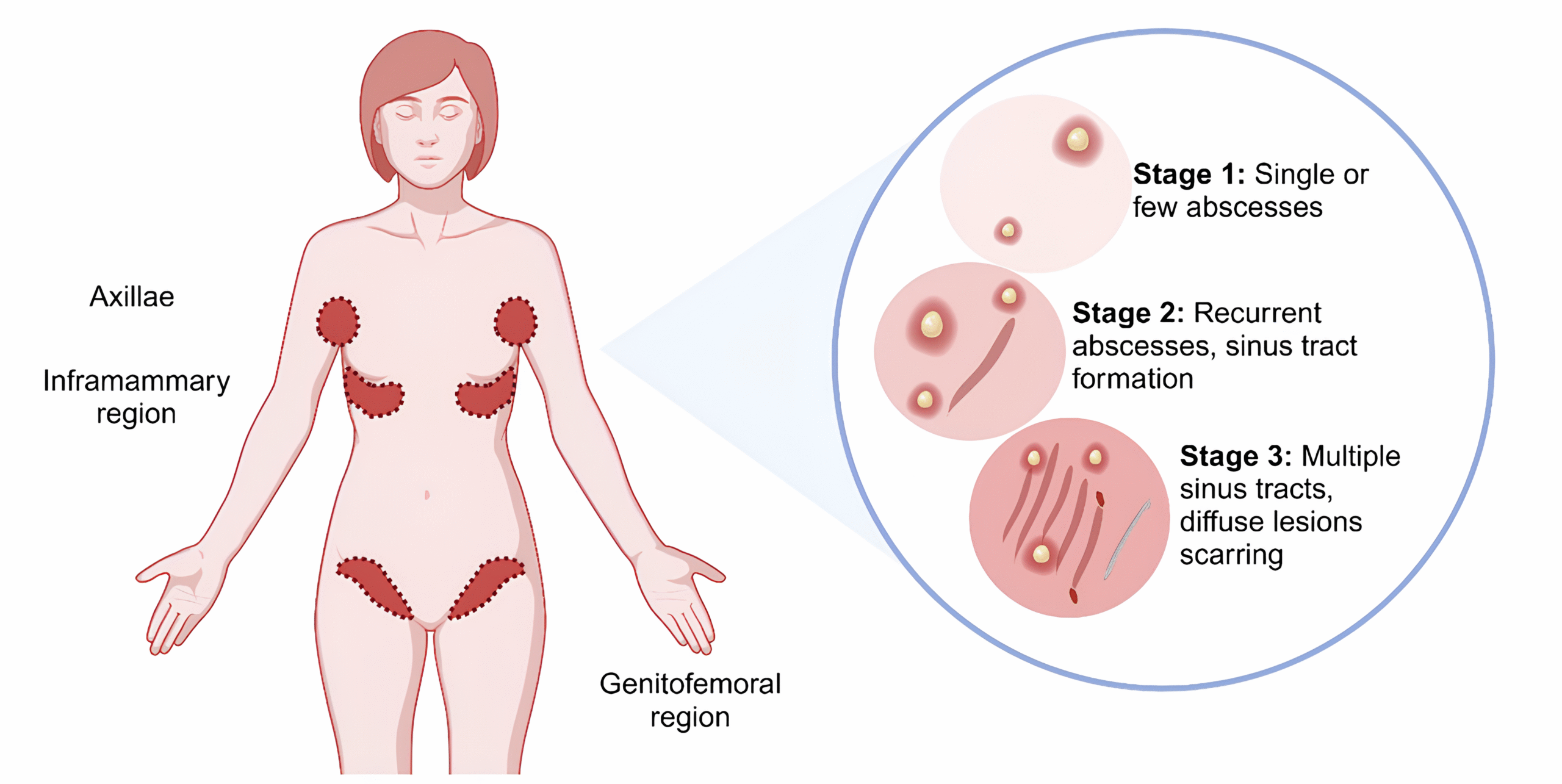
One of the biggest challenges in managing HS is its sheer diversity, what doctors call clinical heterogeneity. Some people experience isolated, deep nodules, others develop extensive, interconnected tunnels, and the severity can range dramatically. For over a decade, researchers have tried various ways to classify HS into distinct phenotypes based on these clinical features, with more than 15 different classification systems proposed.
These efforts aim to bring order to the chaos, hoping that grouping patients might help predict disease progression or treatment response. However, as Dr. Cassius and Dr. Oulès point out, no consensus has emerged. The proposed groups often overlap, different doctors might classify the same patient differently, and the real clinical value of these groupings remains debated. This lack of a clear, universally accepted classification system reflects the deep complexity we face with hidradenitis suppurativa symptoms and stages.
A Proven natural Roadmap to Manage HS
Get the support and natural strategies you need for lasting relief and join a community that understands.

Science Tries to Unpack the Puzzle: The Cluster Study
The commentary discusses a recent study by Passera and colleagues that took a modern, data-driven approach. They used data from over 1000 patients enrolled in the SUNSHINE and SUNRISE clinical trials for secukinumab (an IL-17A inhibitor biologic). Using baseline clinical characteristics (like age, gender, BMI, smoking status, disease severity scores), they applied an unsupervised clustering method, essentially asking a computer to find natural groupings within the data.
This approach identified three distinct clusters:
- Cluster 1 (54% of patients): Primarily obese women with moderate disease severity.
- Cluster 2 (18% of patients): Characterized mainly by less obese, non-smoking, non-white men with an earlier age of disease onset.
- Cluster 3 (28% of patients): Associated with more severe and extensive disease, with a balanced gender distribution.
These subgroups likely reflect the real-world diversity we see in the HS community and highlight that the disease is far more complex than simple Hurley staging can capture. It’s an interesting observation, confirming that different types of HS patients exist within large populations. But the crucial question remains: does this help us figure out how to treat HS more effectively?
Interesting Patterns, But Do They Help Treat HS?
The researchers using the trial data also looked at how patients in each cluster responded to secukinumab versus a placebo. They found that the drug showed efficacy compared to placebo across all three clusters. However, digging deeper, Dr. Cassius and Dr. Oulès note a potential red flag: the response rate at Week 16 (measured by HiSCR50, at least a 50% reduction in inflammatory lesions) was lower in Cluster 3 (the severe group) compared to Cluster 1. They also raise concerns about more patients potentially dropping out or having a flatter response curve in this severe cluster, suggesting, perhaps unsurprisingly, that this group might have more treatment-resistant disease.
But here’s the most critical point highlighted in the commentary: these clinical clusters did not effectively predict treatment response. Knowing which cluster a patient belonged to didn’t reliably tell doctors whether secukinumab would work well for them. This severely limits the practical usefulness of this type of clustering for guiding therapeutic decisions. It tells us that grouping patients based solely on what we can see on the surface (phenotype) isn’t giving us the full picture needed for truly personalized hidradenitis suppurativa treatment or medication choices.
A Proven natural Roadmap to Manage HS
Get the support and natural strategies you need for lasting relief and join a community that understands.

The Missing Pieces: Why Clinical Clusters Aren’t Enough
This brings us to the core limitation discussed by Dr. Cassius and Dr. Oulès: the analysis was based only on clinical features, things doctors can observe or measure externally. It didn’t incorporate any biological markers or molecular signatures from within the skin or blood.
This is where the concept of endotypes comes in. While a phenotype is the outward appearance of the disease, an endotype refers to the specific underlying molecular mechanism driving it. To truly personalize medicine, we need to understand the endotype, the specific type of inflammatory fire raging inside.
The commentary contrasts this clinical clustering with a recent molecular study by Wang et al.. That study analyzed gene expression in HS skin and identified two molecular clusters. One cluster was linked to metabolic pathways and seemed to respond better to adalimumab (a TNF-alpha inhibitor). However, that study didn’t link its molecular clusters back to specific clinical appearances.
This highlights the Knowledge Gap. We have studies looking at clinical appearance (phenotype) and studies looking at molecular mechanisms (endotype), but they aren’t being effectively integrated. As Dr. Cassius and Dr. Oulès state, These complementary efforts… highlight the urgent need to integrate multidimensional datasets. Without connecting the outside appearance to the inside mechanism, we’re still missing crucial pieces of the puzzle.
The HS Arma Philosophy: Beyond Surface-Level Grouping
This call for deeper, integrated understanding resonates perfectly with the philosophy we practice at HS Arma. The limitations of these clustering approaches, their inability to predict treatment response and their focus on downstream characteristics rather than upstream causes, powerfully validate why we focus on foundational health.
Let’s use our core Fire and Smoke Alarm analogy.
- Clinical clustering (phenotyping) is like noticing different patterns in the smoke, maybe it’s thicker here, smells different there. It describes the visible problem but doesn’t explain the source.
- Molecular clustering (endotyping) tries to figure out the type of fire, is it an electrical fire? A grease fire? This gives more clues about the mechanism.
- Conventional treatments, like biologics (secukinumab, adalimumab), are sophisticated fire extinguishers. The clustering studies try to figure out which extinguisher works best for which type of smoke or fire. But as the commentary notes, even with these targeted tools, response rates in HS remain disappointingly low compared to other diseases. Why?
Because they are still primarily focused on fighting the fire or managing the smoke, without asking the most crucial question: What is fueling the fire in the first place?
A Proven natural Roadmap to Manage HS
Get the support and natural strategies you need for lasting relief and join a community that understands.

At HS Arma, we believe the primary path to lasting remission lies in addressing the fuel. We focus upstream on the systemic, body-wide inflammation driven by factors like diet, gut health, chronic stress, hormonal imbalances, and environmental triggers. While the specific type of fire (endotype) or smoke pattern (phenotype) might vary between individuals, the underlying fuel, systemic inflammation, is the common denominator we can target effectively in the vast majority of patients.
This is why our HS Arma approach often leads to massive improvements regardless of the specific subgroup someone might fall into. We focus on highly effective evidence-based nutrition and lifestyle change, and natural therapies and practices to fundamentally change the internal environment, making it less conducive to inflammation.
Does this mean clustering and subtyping aren’t valuable? Not at all. As the commentary suggests, the future likely lies in integrating clinical, molecular, and predictive data. Understanding subtypes might eventually help us refine personalized natural strategies too. But while science continues that complex work, you don’t have to wait. The foundational principles of calming systemic inflammation apply broadly and offer a powerful path to take control now. Biologics remain important tools (powerful temporary shields) but the goal is to build such a resilient internal foundation that these shields become less necessary, or ideally, completely unnecessary.
Key Takeaways
- HS is Highly Variable: Hidradenitis Suppurativa shows up differently in different people, making simple classification difficult.
- Clinical Clusters Offer Clues, Not Answers: Grouping patients by clinical features (like obesity, gender, severity) reveals interesting patterns but doesn’t reliably predict who will respond to specific biologic treatments like secukinumab.
- Deeper Understanding Needed: True personalization requires integrating clinical appearance (phenotype) with underlying biological mechanisms (endotype), which current approaches often fail to do.
- Focus on the Fuel, Not Just the Fire: While clustering tries to categorize the fire or smoke, the most effective strategy for lasting remission involves addressing the root causes, the systemic inflammation (the fuel). Specifically through foundational changes in diet, lifestyle, and additional natural therapies.
A Proven natural Roadmap to Manage HS
Get the support and natural strategies you need for lasting relief and join a community that understands.

Conclusion: Taking Control Amidst Complexity
The research discussed in this commentary confirms what every person living with HS knows deep down: this disease is incredibly complex, and we are still uncovering its many layers. While science strives to categorize and personalize treatments, the reality is that we don’t yet have perfect answers from the conventional medical system. The path forward involves integrating clinical observations with deep biological understanding.
But this complexity doesn’t mean you are powerless. Far from it. While researchers work to map the intricate variations of the HS fire, you hold the power to control the fuel. The fact that clinical clusters don’t reliably predict drug response underscores the limitations of a purely symptom-focused approach and highlights the immense potential of addressing the root cause.
You don’t need to wait for science to perfectly categorize you before you start healing. By focusing on foundational health, calming systemic inflammation through nutrition, lifestyle, stress management, and targeted natural support, you are addressing the common denominator that drives this disease in almost everyone. This is the path we champion at HS Arma. Remission isn’t about finding the one magic drug that matches your subtype; it’s about building a body where the fire simply doesn’t have the fuel to burn. Healing is possible, and it starts with the foundational choices you make today.
Reference
- [1] Cassius, C., & Oules, B. (2025). Clinical clusters in hidradenitis suppurativa: Interesting observations but incomplete answers. Journal of the European Academy of Dermatology and Venereology, 39(8), 1370-1371. https://doi.org/10.1111/jdv.20788
Important Medical Disclaimer
1. Not Medical Advice: All content and information on this website is for informational and educational purposes only. It does not constitute medical advice and is not a substitute for professional diagnosis, treatment, or consultation with a qualified healthcare provider.
2. My Role and Qualifications: I am a biomedical scientist and PhD candidate and share information from that perspective, combined with my personal experience as a patient with Hidradenitis Suppurativa. However, I am not a medical doctor, physician, or registered healthcare professional. Do not consider our relationship a doctor-patient relationship.
3. Consult Your Doctor: Always seek the advice of your medical doctor or another qualified health professional with any questions you may have regarding a medical condition. Never disregard professional medical advice or delay seeking it because of something you have read on this website. If you suspect you are experiencing a medical emergency, or a severe infection, do not rely on this website or the HS Arma community, please call your local emergency services or go to the nearest emergency room immediately.
4. A Critical Warning on Medication: Pharmaceutical drugs are a crucial tool in managing Hidradenitis Suppurativa for many people. Under absolutely no circumstances should you ever alter, reduce, or stop taking your prescribed medication without the explicit direction of the doctor who prescribed it. Doing so can be dangerous. Always consult with your doctor before doing anything related to your treatment plan.
5. No Liability: Your use of this website and reliance on any information provided is solely at your own risk.
6. Individual Results May Vary: Every patient’s biological baseline, genetics, and adherence to the protocol is different. Therefore, I cannot guarantee specific results, cures, or timelines for your Hidradenitis Suppurativa.
7. Scientific and Expressive Freedom: The articles published on this blog are distinct from formal peer-reviewed academic literature. They serve as an independent platform for my personal viewpoints, scientific hypotheses, and philosophical reflections as an independent scientist and HS patient. While grounded in biomedical research, I exercise a degree of expressive freedom to translate rigid academic data into insights from a patient perspective. These writings are my personal meditations on the science of HS and should be read as my individual perspective, not as universally accepted clinical consensus or formal peer-reviewed literature.