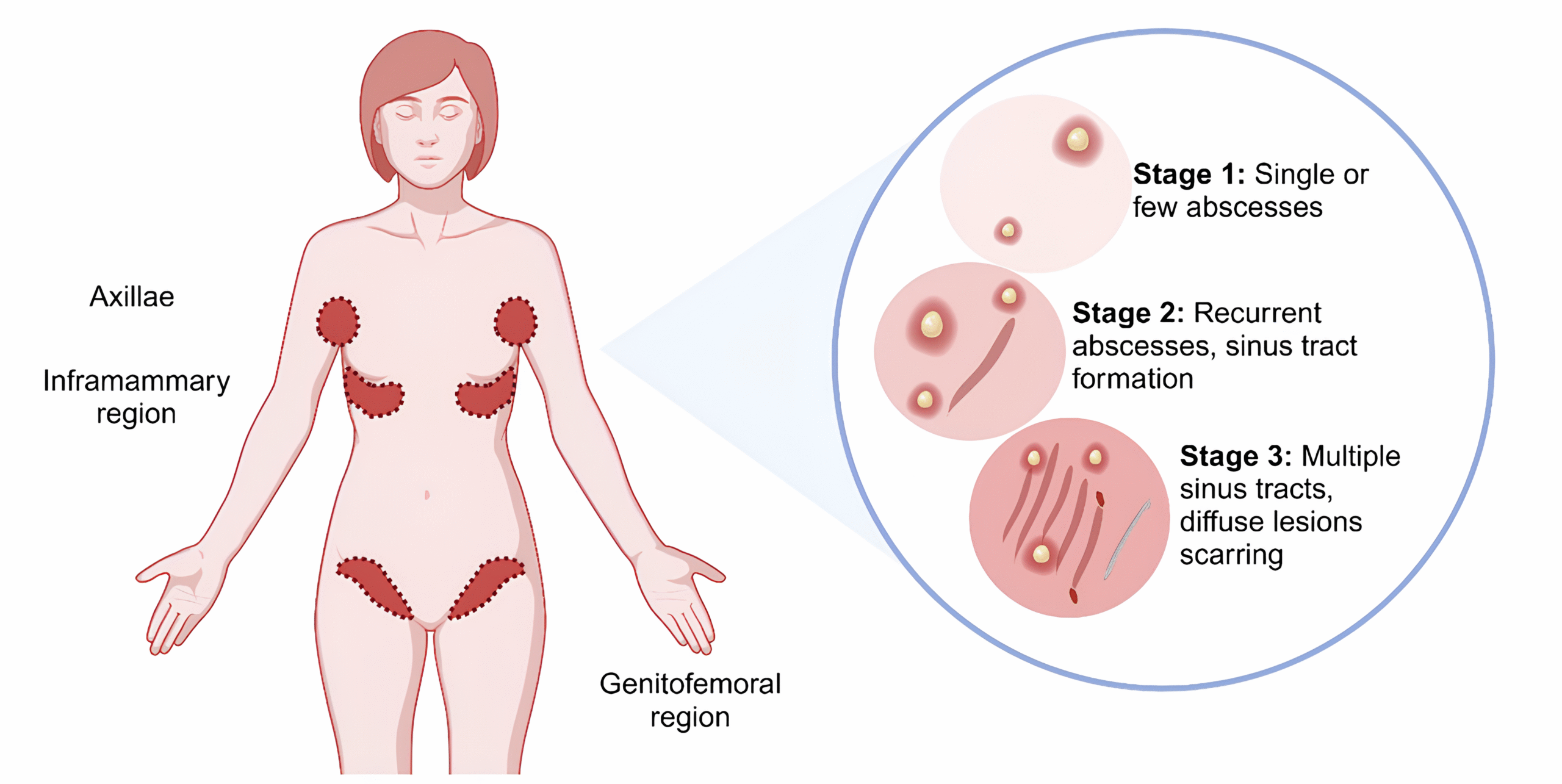

My name is Jaap, and I am a biomedical scientist that also used to live with severe Hidradenitis Suppurativa, the kind that takes over your life. Today, I am completely asymptomatic because I learned how to heal Hidradenitis Suppurativa from within. More importantly, I’ve had the privilege of helping many other individuals with HS get their lives back too.
Introduction: The Two Stories of Hidradenitis Suppurativa
It starts with a familiar, sickening tingle. A deep, internal ache in a place you know all too well, your armpit, your groin, your inner thigh. You run your fingers over the spot and feel it: the dreaded, hard lump forming far beneath the surface. The dread builds as you know what’s coming. Days of escalating pain, swelling, and the agonizing wait for it to either retreat or erupt. You find yourself asking the same defeated question: “Why is this happening again?”
If you have Hidradenitis Suppurativa (HS), you’ve been told a story about what’s happening in your body. It’s the story I was told, and it’s the one most dermatologists tell. They call HS a chronic inflammatory skin disease. The story focuses on the visible chaos: the angry red inflammation, the bacteria that colonize the lesions, and the painful abscesses. Naturally, the treatments all target this chaos. You’re given antibiotics to fight the bacteria, powerful biologic drugs to silence the inflammation, and offered surgery to cut out the damaged tissue. This approach leaves us feeling like we’re in a never-ending war, constantly fighting battles but never winning. We’re just managing an endless series of fires, never finding the arsonist.
But what if that’s the wrong story? What if the inflammation isn’t the beginning of the story, but the explosive, painful end? What if that abscess is just the final act of a drama that has been unfolding silently, deep beneath your skin, for days, weeks or even months?
Today, we’re going on a journey with a microscope. We’re going to look at what dedicated researchers have discovered about the true origin of an HS lesion. This journey will reveal a new story, a more accurate, and ultimately more hopeful, path for how to treat hidradenitis suppurativa. It’s a path that doesn’t focus on endlessly fighting the smoke, but on finally putting out the fire at its source.
A Lesion is Born: The Real Origin of an HS Flare
Before we dive in, I want to express my deepest gratitude to the scientists who are pushing the boundaries of our understanding of HS. The work of researchers like Dr. Robert Dunstan, Dr. Robert Sabat, and their colleagues gives us the images and the concepts to make sense of our own bodies.
The conventional story of HS often starts with an image like the one below.
A Proven natural Roadmap to Manage HS
Get the support and natural strategies you need for lasting relief and join a community that understands.
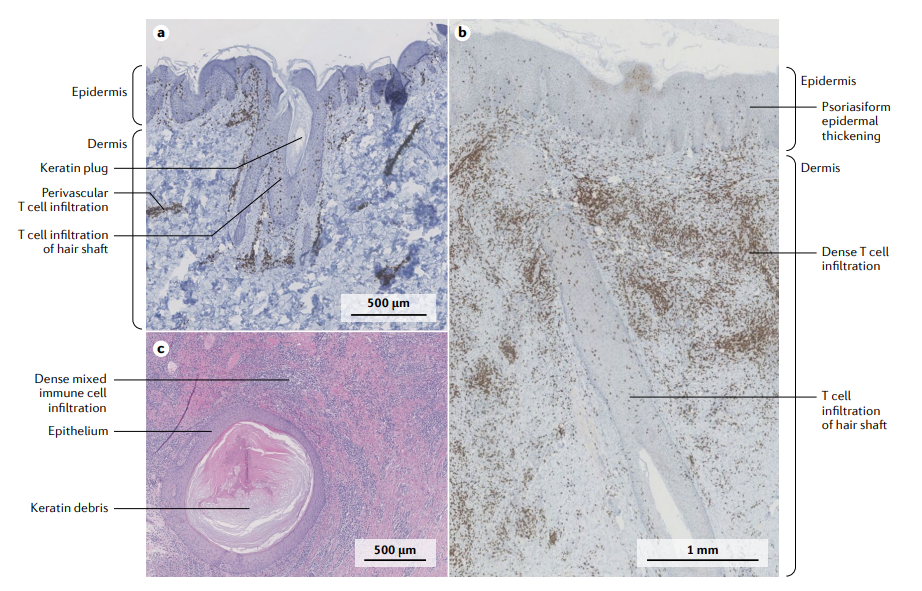
Figure 1. Histology of hidradenitis suppurativa lesions. This image shows skin from an HS lesion. The dark brown specks are immune cells (T cells) that have flooded the area around a hair follicle and the deeper skin layer (dermis). This is the battlefield, the aftermath of a rupture. From Sabat et al. (2020).
This is what doctors typically see under the microscope. It’s a warzone. You can see the immune system’s soldiers (in this case, T cells) swarming the area. Based on this picture, it’s perfectly logical to conclude that HS is a disease of too much inflammation. But this image doesn’t show us how the war started. It only shows us the battle in progress.
To see the real beginning, we have to look at tissue before the explosion, which is exactly what other researchers did.
A Proven natural Roadmap to Manage HS
Get the support and natural strategies you need for lasting relief and join a community that understands.
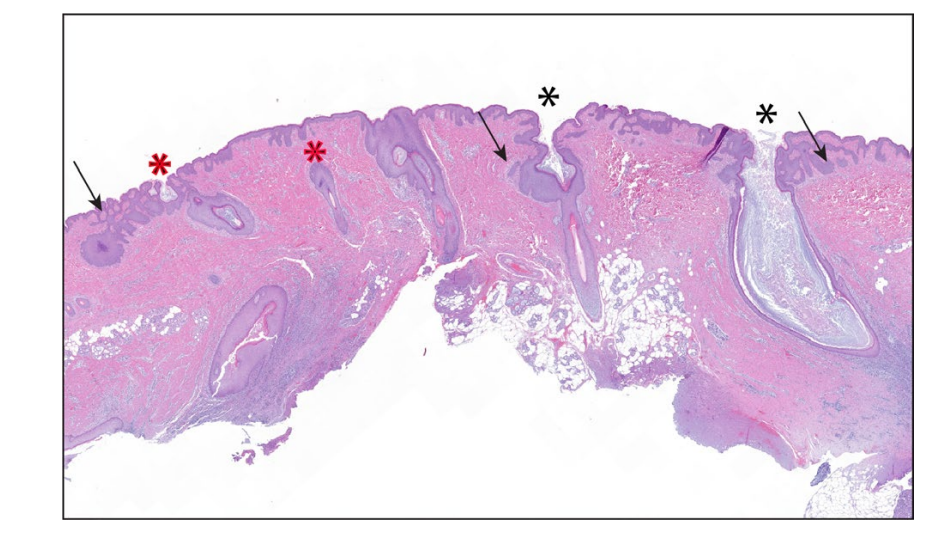
Figure 2. An excisional biopsy from a patient with HS. This image shows a wider view of several hair follicles. The tops of the follicles (marked by asterisks) are abnormally thickened and overgrown. This is the true first step, happening long before a painful flare. Adapted from Dunstan et al. (2021).
This image tells a completely different story. Look closely at the tops of the hair follicles, the part just below the skin’s surface called the infundibulum. They are thickened, misshapen, and overgrown. This process is called hyperplasia, and it’s the very first spark of an HS lesion.1
Think of your hair follicle lining like the brickwork inside a chimney. In a healthy follicle, the bricks are laid in a neat, orderly fashion. In HS, for reasons we’ll get to, the body starts laying way too many bricks. The chimney wall becomes thick, unstable, and overgrown. This happens silently. There’s no pain, no abscess, just this quiet, structural change.
But it’s from this unstable foundation that the true villain of the story emerges. Growing out from the side of these overgrown follicles, researchers have identified invasive, finger-like projections of skin cells that burrow sideways and downwards into your deeper skin tissue. They call them “tendrils”.
A Proven natural Roadmap to Manage HS
Get the support and natural strategies you need for lasting relief and join a community that understands.
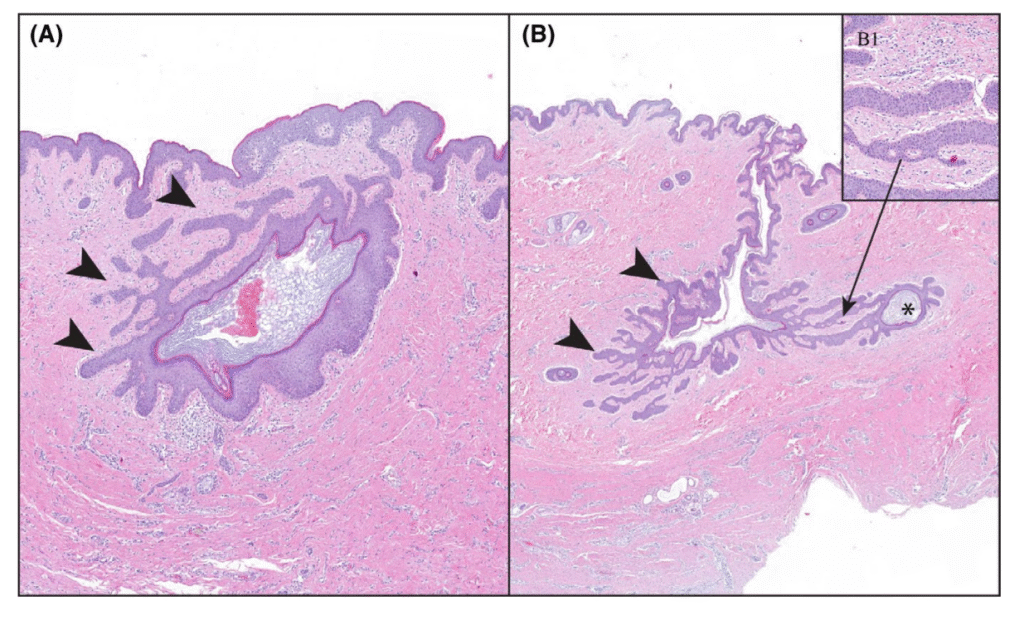
Figure 3. Tendrils are a defining feature of HS. These images show those finger-like extensions (marked by arrowheads) pushing out from the main follicle. Notice the key detail: there isn’t a massive army of inflammatory cells around them yet. The invasion is happening stealthily. Adapted from Dunstan et al. (2021).
These tendrils are the missing link. They explain the deep, interconnected tunnels that are the hallmark of more advanced HS. These aren’t just random channels carved out by pus; they are actively growing structures that create a permanent subway system for the disease to spread. This is why lesions often recur in the same channels and why you can sometimes feel those hard, “rope-like” scars under the skin. It’s the tendril, building its network.
The Invasion Below: How Tendrils Create a Hidden Battlefield
Once born, these tendrils begin their silent invasion, extending far from the original hair follicle. They are like the roots of a destructive weed, spreading unseen underground, building a hidden battlefield.
As these tendrils grow, they can seal off and start to fill with keratin—the same protein that makes up your hair and the outer layer of your skin. This process forms deep, hidden cysts.1
My favorite analogy for this is to think of each tendril as a rogue construction crew building a tunnel to nowhere. Eventually, they wall off a section of the tunnel, creating a sealed-off room deep underground. Then, they start filling that room with cellular debris (keratin). This room is a ticking time bomb, waiting to explode.
When you look at tissue from severe, Hurley stage III HS, you can see the devastating extent of this underground network.
A Proven natural Roadmap to Manage HS
Get the support and natural strategies you need for lasting relief and join a community that understands.
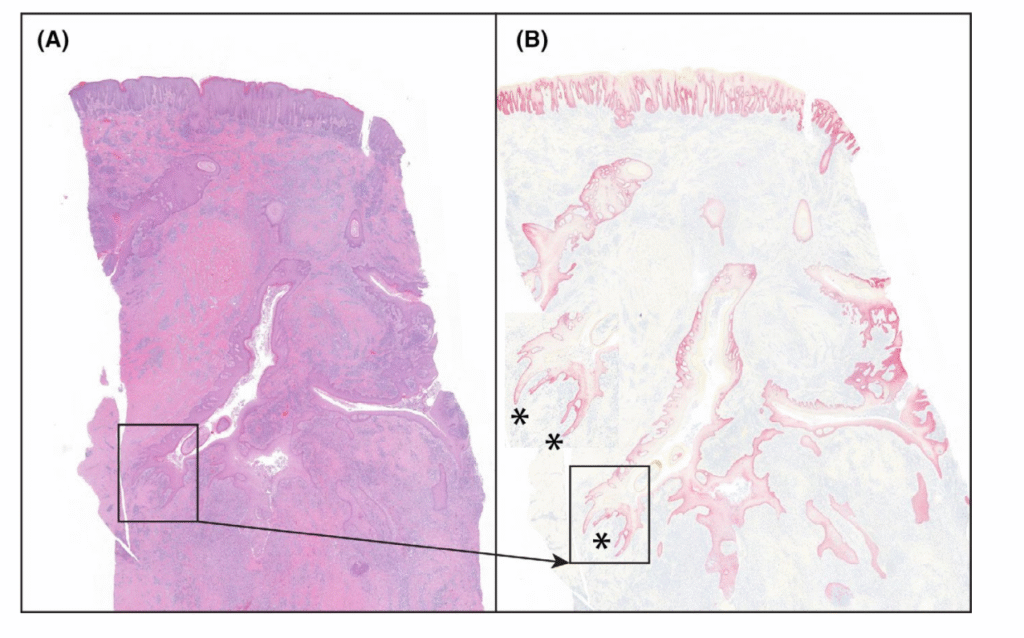
Figure 4. Severely inflamed Hurley stage III. This is a cross-section of what advanced HS looks like deep in the tissue. The branching, pink-stained structures (marked by asterisks) are a massive, interconnected labyrinth of these tendrils and cysts. This entire network was built by those rogue construction crews. From Dunstan et al. (2021).
This changes everything. The scientific language used to describe this process—”infiltrative growth,” “disordered maturation,” “de novo expression of stem cell markers”, paints a picture not of a simple inflammatory disease, but of a fundamental misbehavior of your skin’s epithelial cells.1
This is a profound shift in understanding. It suggests the root problem isn’t just a hyperactive immune system, but a flaw in the signals that tell these follicle cells how to grow and behave. This provides a much stronger scientific reason for the philosophy we follow at HS Arma. We focus on changing the body’s internal signaling environment (root cause) through evidence-based nutrition and lifestyle and naral therapies and practices to correct this disordered process at its source, rather than just mopping up the inflammatory mess it leaves behind.
The Rupture: Why HS Flares Hurt So Much
So you have this deep, hidden network of keratin-filled cysts, these ticking time bombs. The “big bang” event (the moment a flare is born) is when one of them finally breaches or ruptures.
This schematic diagram beautifully illustrates the entire tragic play, from start to finish.
A Proven natural Roadmap to Manage HS
Get the support and natural strategies you need for lasting relief and join a community that understands.
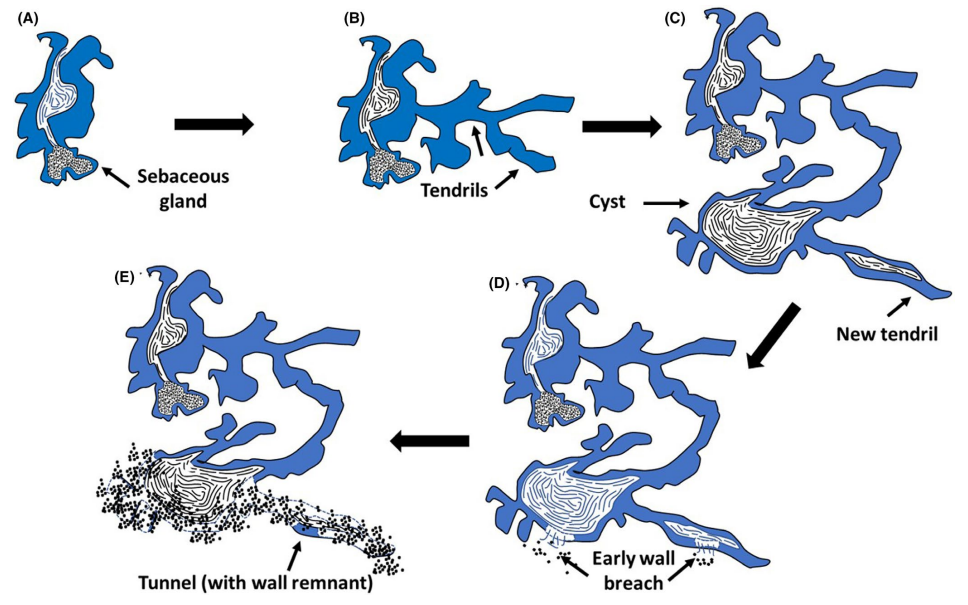
Figure 5. Proposed histologic progression of HS. (A) The quiet beginning: overgrowth of the follicle lining. (B) The invasion: tendrils start to burrow. (C) The time bomb: a deep cyst forms. (D) The breach: the cyst wall breaks. This is the critical moment. (E) The explosion: the contents spill out, the immune system floods in, and a painful, pus-filled tunnel is formed. Adapted from Dunstan et al. (2021).
The keratin and bacteria that were sealed inside the cyst are suddenly dumped into the surrounding tissue where they absolutely do not belong. Your immune system sees this as a catastrophic invasion and sounds a five-alarm fire bell.
The intense, throbbing pain, the heat, the swelling, and the pus of an HS flare is your body’s massive, chaotic, but ultimately secondary response to that rupture. It’s the smoke alarm blaring, but the fire (the tendril-forming process) started long before.
A single piece of skin from a person with HS can show all these different stages happening at once, which is why the disease is so complex.
A Proven natural Roadmap to Manage HS
Get the support and natural strategies you need for lasting relief and join a community that understands.
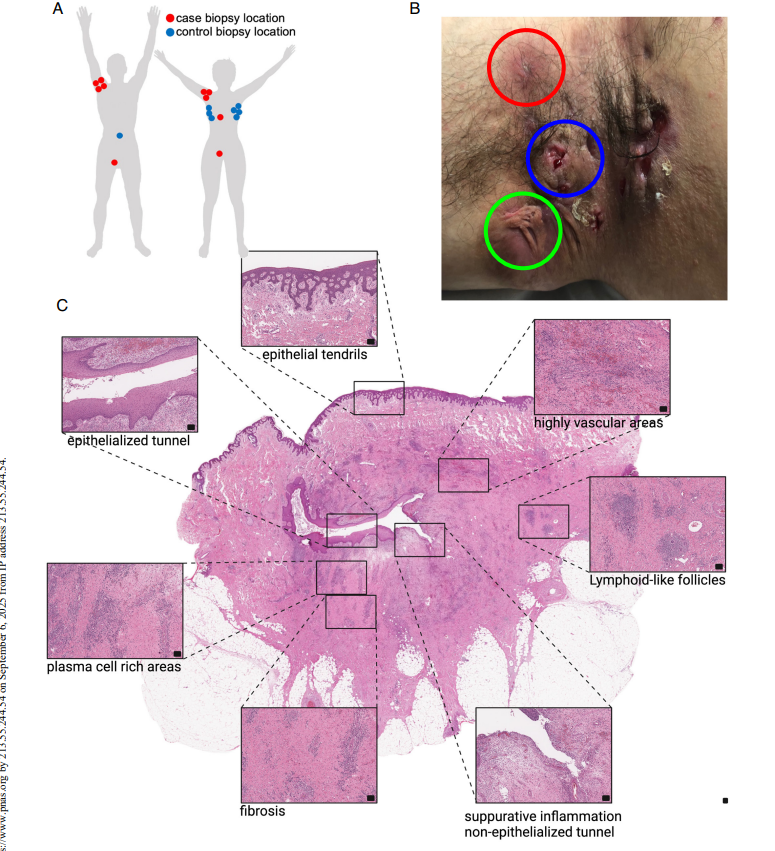
Figure 6. The complex HS battlefield. This single piece of excised tissue shows everything at once: an epithelialized tunnel (a healed tendril), areas of intense inflammation, fibrosis (scarring), and even lymphoid follicles where immune cells organize. It’s a complex, ever-changing warzone. Adapted from Nebo et al. (2024).
This is where we can finally understand the “knowledge gap” in conventional medicine and why so many treatments feel like a dead end. The entire conventional approach is designed to deal with the emergency after the bomb has already gone off.
- Antibiotics: They’re sent in to kill some of the bacteria scattered in the wreckage. But they do absolutely nothing to stop the next tendril from growing or the next cyst from forming.
- Biologics (Anti-TNF drugs, etc.): These are powerful and can bring incredible relief. They work by essentially cutting the wires to the smoke alarm. They tell your immune system to calm down, reducing the inflammation. But they don’t stop the tendrils from growing and rupturing. The fire is still smoldering, and the moment the drug wears off or your body adapts, the alarm comes right back on.
- Surgery: Surgery is like demolishing the fire-damaged part of the building. It can be a necessary and life-changing tool for removing established tunnels and scarred tissue. But if the faulty wiring, the systemic drivers causing the follicles to overgrow, isn’t fixed, a new fire will just start in the building next door.
“24/7 Pain… Nothing Seems to Work”: Voices from the HS Patients
This scientific story is fascinating, but it’s meaningless if it doesn’t connect to the raw, human reality of living with this disease. For years, we as patients have been trying to describe this experience to doctors who didn’t always have the framework to understand it. Now, science is finally providing the images and frameworks but unfortunately a medical system driven by pharmaceutical profits is not going to adopt this knowledge because allot of money can be made on the backs of sick and suffering HS patients.
Our experiences are not just “in our heads”; they are written in our histology.
The Physical Reality (The Rupture and its Aftermath)
The deep, painful, and unpredictable nature of the cyst rupture is a universal theme.
“I’ve been living with the stupid skin disease for about 7 years now. And it fucking sucks…. I hate being able to touch and feel a ping pong ball-sized pus-filled pocket underneath my skin.”
“Sometimes I have abscesses so large, that I can’t walk for days.”
“The times where you’re at work or out socialising and an abscess bursts. You try to get the bleeding under control in a toilet cubicle whilst doing everything you can to not cry.”
A Proven natural Roadmap to Manage HS
Get the support and natural strategies you need for lasting relief and join a community that understands.

The Frustration with Ineffective Treatments (Fighting the Smoke)
The cycle of hope and disappointment with treatments that only target symptoms is a source of immense frustration and leads to tremendous unnecessary suffering.
“Been going through this for years 20 plus. I have tried everything. Nothing seems to work. It seems to get worse as I age. I have been on antibiotics, Humana…”
“There’s no cure… nothing except daily dose of antibiotics. Every. Single. Day. I fucking hate this stupid thing.”
The Agonizing Wait for a Diagnosis (The Invisible Invasion)
Because the initial stages of HS are happening invisibly, deep underground, the diagnostic delay is notoriously long, leaving people to suffer in confused silence for years.
“I first started showing signs of HS in 10th grade and suffered for four years before I even heard the name hidradenitis.”
“I have been asking doctors about this for literally 10 years now, and NO ONE has ever been able to give me an actual diagnosis.”
The Patient-Led Search for Root Causes (Looking for the Arsonist)
Frustrated by the limitations of the conventional model, the HS community has been a powerful force in uncovering the importance of foundational health, particularly diet.
“In the beginning, I didn’t understand why I was experiencing so many flare-ups, and my dermatologist never mentioned that diet could play a role in managing my symptoms. It wasn’t until I joined Facebook support groups that I finally learned the impact of food on HS.”
Your pain is real. Your frustration is valid. You are not imagining it. The reason so many treatments have failed you is that they have been targeting the smoke, not the fire. But what if we could stop the fire from ever starting?
The HS Arma Philosophy: How to Treat HS by Rebuilding the Foundation
This new understanding of HS as an “epithelial-driven disease” doesn’t just change the story; it demands a completely new approach to treatment. We have to stop asking, “How do we suppress this inflammation?” and start asking the real question:
A Proven natural Roadmap to Manage HS
Get the support and natural strategies you need for lasting relief and join a community that understands.

“What is causing the hair follicle lining to overgrow in the first place?”
The answer lies in the systemic environment of your body. The “soil” in which these tendrils grow is a body in a state of chronic, low-grade, systemic inflammation and metabolic dysregulation. This is the true upstream cause, the faulty wiring that signals the follicle cells to misbehave. Our goal, therefore, is to change the soil.
At HS Arma, we flip the conventional treatment pyramid on its head.
The Foundation (Our Primary Focus): This is where true, lasting healing begins. This is how we put out the fire. At HS Arma we focus on highly effective evidence-based nutrition and lifestyle change, and natural therapies and practices.
- Evidence-Based Nutrition: This is the cornerstone. It involves a systematic process to identify and remove your personal inflammatory trigger foods and flooding your body with powerful anti-inflammatory nutrients.
- Strategic Supplementation: Using targeted, science-backed natural compounds like zinc and niacinamide, and many others to help calm the inflammatory cascade and support skin healing from within but also from the level of the skin itself.
- Lifestyle & Stress Management: Mastering sleep and using science-backed techniques to regulate your nervous system. Chronic stress keeps your immune system on high alert, and calming it is non-negotiable for healing.
The Tools (Conventional Medicine as a Shield):
We absolutely recognize that pharmaceuticals and surgery are powerful and sometimes necessary tools. They are a powerful, temporary shield. They can protect you from the worst of the inflammation, drain painful abscesses, and remove debilitating scar tissue, giving you the space and relief you need to do the foundational work of rebuilding your health from the inside out.
The ultimate goal is to build such a strong foundation of health that these powerful shields become less necessary, or ideally, completely unnecessary. This is a core principle we put into practice every day in the HS Arma community.
Here is a table summarizing the two ways of looking at this disease:
| Feature | Conventional “Smoke Alarm” View | HS Arma “Root Cause” View |
| Primary Problem | Treating inflammation and bacterial infection as it appears. Focus on end stage of flare cycle. | Disordered growth (hyperplasia) of the hair follicle lining, leading to invasive “tendrils.” Al due to a HS inappropriate lifestyle |
| Primary Target | Suppress inflammation, kill bacteria. | Correct the underlying systemic drivers that cause follicular overgrowth. |
| Role of Diet/Lifestyle | A adjuvant therapy. | The foundational, primary pillar of treatment. |
| Natural therapies and practices | Very minor focus almost non-existent. | Very strong focus and expert on treating HS naturally. |
| Role of Drugs/Surgery | The main solution. | A powerful but temporary shield used to manage severe symptoms while foundational healing occurs. |
| Patient Goal | Manage symptoms and flares. | Achieve lasting remission by addressing the root cause. |
Key Takeaways for Your Healing Journey
- HS is not just a skin disease; it starts with a structural problem. The true origin is the overgrowth of your hair follicle lining, which forms deep, invasive tendrils.
- Painful flares are the end of the story, not the beginning. The intense inflammation you feel is a secondary reaction to a deep cyst rupturing, not the root cause of the disease itself.
- Conventional treatments often fail because they target the symptoms (the smoke alarm) not the cause (the fire). True healing requires shifting focus from suppressing inflammation to addressing the systemic drivers that cause the follicles to misbehave.
- You can take control by focusing on the foundation. By using evidence-based nutrition, lifestyle changes, and natural therapies to calm systemic inflammation, you can change the “soil” in which HS grows, making it possible to achieve lasting remission.
Conclusion: You Are Not Broken, and Healing is Possible
For years, maybe decades, you’ve been told a story about Hidradenitis Suppurativa that likely made you feel broken, helpless, and at war with your own body. But the science we’ve explored today tells a new story. It’s a story that makes sense, a story that validates your experience, and most importantly, a story that shows a clear, logical path forward.
Your body is not your enemy. It has an incredible, innate capacity to heal. The pain and inflammation of HS are not a sign that your body is failing you; they are a desperate signal that something deeper is wrong. By finally listening to that signal and addressing the true root cause, the systemic fire that leads to disordered growth, you can put out that fire for good.
This is the foundational work we focus on at HS Arma, helping people move from just surviving to truly thriving. You are not alone on this journey. Healing is not just possible; it is your birthright.
A Proven natural Roadmap to Manage HS
Get the support and natural strategies you need for lasting relief and join a community that understands.

Important Medical Disclaimer
1. Not Medical Advice: All content and information on this website is for informational and educational purposes only. It does not constitute medical advice and is not a substitute for professional diagnosis, treatment, or consultation with a qualified healthcare provider.
2. My Role and Qualifications: I am a biomedical scientist and PhD candidate and share information from that perspective, combined with my personal experience as a patient with Hidradenitis Suppurativa. However, I am not a medical doctor, physician, or registered healthcare professional. Do not consider our relationship a doctor-patient relationship.
3. Consult Your Doctor: Always seek the advice of your medical doctor or another qualified health professional with any questions you may have regarding a medical condition. Never disregard professional medical advice or delay seeking it because of something you have read on this website. If you suspect you are experiencing a medical emergency, or a severe infection, do not rely on this website or the HS Arma community, please call your local emergency services or go to the nearest emergency room immediately.
4. A Critical Warning on Medication: Pharmaceutical drugs are a crucial tool in managing Hidradenitis Suppurativa for many people. Under absolutely no circumstances should you ever alter, reduce, or stop taking your prescribed medication without the explicit direction of the doctor who prescribed it. Doing so can be dangerous. Always consult with your doctor before doing anything related to your treatment plan.
5. No Liability: Your use of this website and reliance on any information provided is solely at your own risk.
6. Individual Results May Vary: Every patient’s biological baseline, genetics, and adherence to the protocol is different. Therefore, I cannot guarantee specific results, cures, or timelines for your Hidradenitis Suppurativa.
7. Scientific and Expressive Freedom: The articles published on this blog are distinct from formal peer-reviewed academic literature. They serve as an independent platform for my personal viewpoints, scientific hypotheses, and philosophical reflections as an independent scientist and HS patient. While grounded in biomedical research, I exercise a degree of expressive freedom to translate rigid academic data into insights from a patient perspective. These writings are my personal meditations on the science of HS and should be read as my individual perspective, not as universally accepted clinical consensus or formal peer-reviewed literature.