
My name is Jaap, and I am a biomedical scientist that also used to live with severe Hidradenitis Suppurativa, the kind that takes over your life. Today, I am completely asymptomatic because I learned how to heal Hidradenitis Suppurativa from within. More importantly, I’ve had the privilege of helping many other individuals with HS get their lives back, too.
Introduction: When Lab Tests Add Confusion to the Chaos
Living with Hidradenitis Suppurativa (HS) can often feel like trying to solve a puzzle in the dark. You’re dealing with the pain, the unpredictable flares, the frustration – and then sometimes, the medical system throws another curveball. Maybe it’s a confusing lab result, something flagged as abnormal that sends doctors down a rabbit hole, leading to more tests, more worry, and maybe even treatments that don’t seem to help your actual HS. Does this sound familiar?
It’s a lonely place to be, and it highlights a critical issue in understanding how to treat Hidradenitis Suppurativa effectively. A recent case report published in Frontiers in Medicine by Dr. Andrew J. Gauger and colleagues perfectly illustrates this challenge [1]. They describe the harrowing journey of a young woman with severe HS whose unusual lab results led to a misdiagnosis and potentially harmful treatment, all while her underlying HS continued to rage.
This story isn’t just about one person’s experience; it’s a powerful lesson about the systemic nature of HS and the dangers of chasing symptoms or lab numbers (the smoke alarms) without addressing the root cause (the fire). Let’s break down this case and see what it teaches us about finding a clearer path to healing.
A Case of Mistaken Identity: When HS Gets Ignored
First, my sincere thanks to Dr. Gauger and the team for documenting this case. It takes courage to highlight instances where the system doesn’t get it right, and their work provides invaluable insights for both patients and clinicians.
Their report details the story of a 23-year-old woman with a decade-long history of severe, Hurley stage III Hidradenitis Suppurativa (HS). Despite being on adalimumab (a biologic drug), she was hospitalized with a month-long history of systemic symptoms: weight loss, nausea, persistent fevers, and fatigue. During her hospital stay, doctors noted jaw swelling (sialadenitis) and ran extensive tests.
One result stood out: significantly elevated levels of a specific type of antibody called Immunoglobulin G4 (IgG4). You can see her timeline and lab results below.
A Proven natural Roadmap to Manage HS
Get the support and natural strategies you need for lasting relief and join a community that understands.
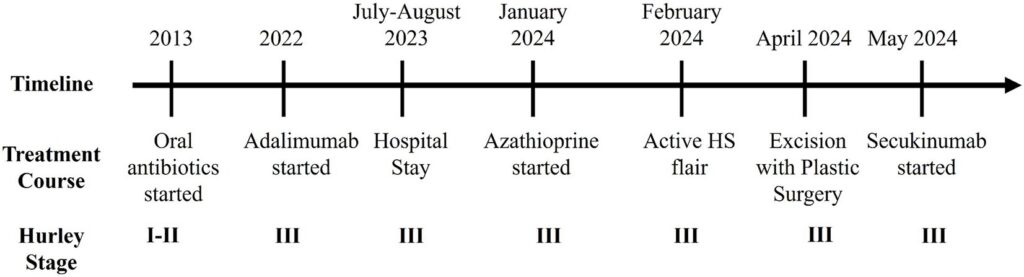
Figure 1: Patient Timeline. This figure summarizes the key events in the patient’s treatment course, showing the progression from initial antibiotics to biologics, the confusing hospital stay, the trial of azathioprine based on the suspected IgG4-RD diagnosis, a subsequent severe HS flare requiring surgery, and finally switching to another biologic, secukinumab. Figure by Dr. Andrew J. Gauger and colleagues.
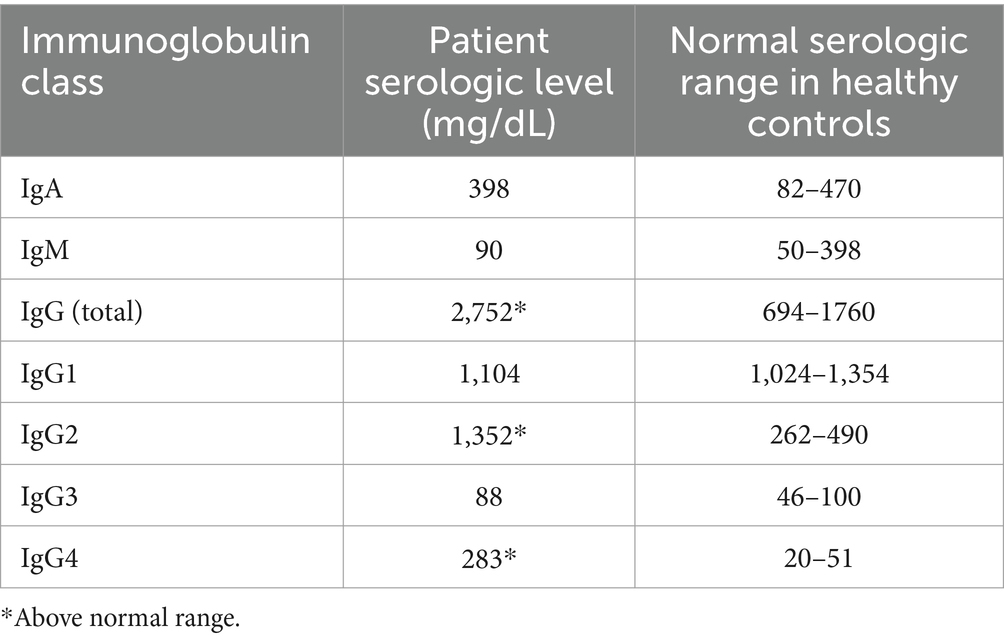
Table 1: Patient’s Immunoglobulin Levels. This table compares the patient’s serum immunoglobulin levels to the normal range found in healthy controls. Notice the total IgG is significantly elevated (2,752 mg/dL vs. a normal range up to 1,760 mg/dL), and IgG4 is dramatically higher (283 mg/dL vs. a normal range up to 51 mg/dL). These high levels, particularly IgG4, became the focus of the subsequent diagnostic chase. Table from Dr. Andrew J. Gauger and colleagues.
This elevated IgG4, combined with the jaw swelling, led the hospital team down the path of suspecting a rare condition called IgG4-Related Disease (IgG4-RD), even though biopsies of her lymph node and parotid gland did not support this diagnosis. Despite the negative biopsy, she was diagnosed with suspected IgG4-RD upon discharge and later started on azathioprine, a potent immunosuppressant often used for this condition.
What happened next? Her HS got worse. Six months later, she presented to the dermatology clinic with an active, severe HS flare, requiring urgent surgery and a switch to a different biologic medication. The azathioprine, prescribed for a condition she likely didn’t have, did nothing for her HS and potentially allowed it to progress unchecked.
A Proven natural Roadmap to Manage HS
Get the support and natural strategies you need for lasting relief and join a community that understands.
What is IgG4 Anyway? A Confusing Signal from the Battlefield
So, what exactly is IgG4, and why did its elevation cause such confusion? IgG4 is one of the four subclasses of Immunoglobulin G, the most common type of antibody in our blood. Antibodies are crucial proteins our immune system uses to identify and neutralize threats.
However, IgG4 is a bit of an oddball. As the researchers note, it can have both pro-inflammatory and anti-inflammatory roles depending on the situation. Think of it less like a clear attack signal and more like a complex messenger whose meaning changes based on the context of the battle.
Crucially, elevated IgG4 isn’t exclusive to IgG4-RD. Studies have shown it can be high in various conditions involving chronic inflammation, including autoimmune diseases like Rheumatoid Arthritis (RA), certain infections, and even some cancers. It might be a sign of the body trying to dampen down a long-standing inflammatory response, or it could be part of the problem itself. The bottom line: finding elevated IgG4 doesn’t automatically mean someone has IgG4-RD.
Connecting the Dots: HS, Chronic Inflammation, and Your Immune System
This brings us back to the patient’s case and the central truth about Hidradenitis Suppurativa causes. Severe HS is a state of intense, chronic, systemic inflammation. We already know from other research that people with severe HS often have elevated total IgG levels, and that these levels can reflect disease severity. In fact, one study suggested that an IgG level above 1,300 mg/dL is predictive of Hurley Stage III disease, this patient’s level was over 2,700 mg/dL!
Given this underlying state of massive immune activation, is it really surprising that one specific subclass, IgG4, might also be elevated? As the authors reasonably conclude, the severe HS itself is a plausible explanation for the high IgG4 levels, especially since the extensive workup for other causes (infection, cancer, true IgG4-RD) was negative.
The paper also touches on anti-drug antibodies (ADAs). It’s possible the patient developed IgG4 antibodies against adalimumab, which can happen with long-term biologic use. However, it’s unclear if this alone would account for such high total IgG4 levels. The most likely scenario is that the elevated IgG4 was primarily another signal reflecting the severity of her underlying HS inflammation, the fire that was never properly addressed.
The Knowledge Gap: The Danger of Chasing Lab Results
This case study is a perfect, albeit tragic, illustration of the knowledge gap in conventional medicine. Doctors saw an abnormal lab value, the elevated IgG4, a piece of smoke, and immediately focused on diagnosing a rare disease associated with that marker, IgG4-RD. They went down a path of invasive biopsies and prescribed a powerful immunosuppressant (azathioprine) based on suspicion, even when the biopsy evidence wasn’t there.
In doing so, they seemingly overlooked the massive, ongoing fire right in front of them: the patient’s severe, uncontrolled Hurley Stage III HS. They were so focused on the unusual smoke signal that they ignored the inferno causing it. This downstream, symptom-chasing approach failed to guide the patient into preventing getting the same problem 5 years down the line.
Reading this young woman’s story truly hits close to home, and honestly, it fills me with a deep sense of sadness and frustration. Here is someone battling severe HS, likely for much of her young adult life, grappling with the immense physical and emotional toll this disease takes. She sought help, was hospitalized, endured invasive tests, and was ultimately led down a path focused on a rare disease based on a single, misleading lab marker. All the while, the real culprit, the raging, systemic inflammation of her severe HS, was treated as a secondary issue, almost an afterthought. Imagine the confusion, the fear, the lost time spent on treatments that didn’t address the core problem, possibly even worsening it. This isn’t just a failure of diagnosis; it’s a failure of perspective. It’s the heartbreaking result of a system so focused on the downstream smoke, the symptoms, the lab results, that it completely misses the upstream fire. The real path to potentially controlling her HS and avoiding years of suffering and invasive procedures like surgery, were likely waiting in foundational changes, in understanding her unique triggers through diet, lifestyle, and targeted natural support. This decade-long struggle didn’t have to unfold this way. It’s a stark reminder of why we must look deeper, why we must empower ourselves to address the root cause, because waiting for the conventional system to lead to severe and interventions seen in this case.
A Proven natural Roadmap to Manage HS
Get the support and natural strategies you need for lasting relief and join a community that understands.
The HS Arma Philosophy: Treating the Fire, Not the Alarms
This is precisely why the HS Arma philosophy reverses the conventional model. We don’t start by chasing downstream symptoms or lab abnormalities. We start by asking: Why is the immune system so dysregulated in the first place? What is fueling the systemic fire?
At HS Arma, we focus on highly effective evidence-based nutrition and lifestyle change, and natural therapies and practices as the main treatment. Pharmaceuticals are viewed as powerful, temporary shields – sometimes necessary to control a crisis – but they are not the foundation. The foundation is restoring balance to the body.
When you focus on putting out the fire through foundational strategies:
- Foundational Nutrition: Identifying your personal inflammatory food triggers and nourishing your body with anti-inflammatory foods.
- Strategic Lifestyle Changes: Mastering sleep, managing stress (a huge immune trigger!), and reducing environmental toxin exposure.
- Natural Therapies & Skincare: Using targeted, science-backed natural compounds and appropriate skincare to support immune balance and skin healing.
- Accountability & Support: Having a community and guidance to stay the course.
- Targeted Medical Testing: Using tests wisely to understand your unique physiology, not just chase numbers.
…then the downstream abnormalities, including confusing lab results like elevated IgG4, often begin to normalize on their own. Why? Because you’ve addressed the root cause. You’ve calmed the systemic inflammation that was causing the immune system to send out these chaotic signals.
Key Takeaways
- HS is Systemic: Severe Hidradenitis Suppurativa (HS) is a state of chronic, body-wide inflammation that can cause various laboratory abnormalities, including elevated total IgG.
- Elevated IgG4 Isn’t Always IgG4-RD: High IgG4 can be seen in many chronic inflammatory conditions and may simply reflect the overall immune activation in severe HS, not necessarily a separate disease.
- Treat the Fire, Not the Smoke Alarm: The most effective approach is to address the root cause – the systemic inflammation driving HS, through foundational changes in diet, lifestyle, and targeted natural therapies. This is the path to lasting remission.
Conclusion: Trust Your Body, Seek the Root Cause
This case study is a powerful reminder that Hidradenitis Suppurativa symptoms and associated lab findings can be complex. Your body isn’t just a collection of parts; it’s an interconnected system. The inflammation driving your HS doesn’t stay confined to your skin; it echoes throughout your immune system, sometimes creating confusing signals like elevated IgG4.
Can you cure HS? While there’s no magic pill, achieving deep, lasting remission is possible. But it requires looking beyond the surface, beyond the smoke alarms, and focusing on extinguishing the underlying fire. Don’t let confusing lab results or diagnostic uncertainty derail your healing journey. Trust what your body is telling you. Seek out approaches that address the root cause of inflammation. Healing starts from within.
A Proven natural Roadmap to Manage HS
Get the support and natural strategies you need for lasting relief and join a community that understands.
Reference
- [1] Gauger, A. J., Fritz, M., & Burgin, C. B. (2024). IgG4 serologic elevation in a patient with severe hidradenitis suppurativa: a case report and review of the literature. Frontiers in Medicine, 11, 1471226. https://doi.org/10.3389/fmed.2024.1471226
Important Medical Disclaimer
1. Not Medical Advice: All content and information on this website is for informational and educational purposes only. It does not constitute medical advice and is not a substitute for professional diagnosis, treatment, or consultation with a qualified healthcare provider.
2. My Role and Qualifications: I am a biomedical scientist and PhD candidate and share information from that perspective, combined with my personal experience as a patient with Hidradenitis Suppurativa. However, I am not a medical doctor, physician, or registered healthcare professional. Do not consider our relationship a doctor-patient relationship.
3. Consult Your Doctor: Always seek the advice of your medical doctor or another qualified health professional with any questions you may have regarding a medical condition. Never disregard professional medical advice or delay seeking it because of something you have read on this website. If you suspect you are experiencing a medical emergency, or a severe infection, do not rely on this website or the HS Arma community, please call your local emergency services or go to the nearest emergency room immediately.
4. A Critical Warning on Medication: Pharmaceutical drugs are a crucial tool in managing Hidradenitis Suppurativa for many people. Under absolutely no circumstances should you ever alter, reduce, or stop taking your prescribed medication without the explicit direction of the doctor who prescribed it. Doing so can be dangerous. Always consult with your doctor before doing anything related to your treatment plan.
5. No Liability: Your use of this website and reliance on any information provided is solely at your own risk.
6. Individual Results May Vary: Every patient’s biological baseline, genetics, and adherence to the protocol is different. Therefore, I cannot guarantee specific results, cures, or timelines for your Hidradenitis Suppurativa.
7. Scientific and Expressive Freedom: The articles published on this blog are distinct from formal peer-reviewed academic literature. They serve as an independent platform for my personal viewpoints, scientific hypotheses, and philosophical reflections as an independent scientist and HS patient. While grounded in biomedical research, I exercise a degree of expressive freedom to translate rigid academic data into insights from a patient perspective. These writings are my personal meditations on the science of HS and should be read as my individual perspective, not as universally accepted clinical consensus or formal peer-reviewed literature.